Table of Contents
- Best Web Design Services for Startups: Top Picks Compared
- Custom vs Template Website for Startups: Which Should You Choose?
- Web Design Pricing for Startups: What to Budget in 2026
- Startup Website Design Best Practices That Drive Results
- Web Design Timeline for Startups: How Long Will It Take?
- How to Choose the Best Web Design Service for Your Startup
- Conclusion
Last Updated: June 3, 2026
Best Web Design Services for Startups: Top Picks Compared
Choosing the best web design services for startups is one of the highest-stakes decisions a founding team makes. Your website is often the first credibility signal investors, customers, and partners encounter. Teams that invest in purposeful design early convert better, raise faster, and build brand equity that compounds. Below, we break down the top options across every budget and use case, plus the frameworks you need to make the right call.

Here is a quick-reference comparison before the deep dives:
| Service | Best For | Starting Price | Model |
|---|---|---|---|
| Web Maniacs | Full-service startup growth | See pricing page | Custom project |
| Clay | VC-backed tech startups | Contact for quote | Project-based |
| Webflow | Design control, no engineering team | $14/month | Subscription |
| Goji Labs | MVP development | $25,000 | Project-based |
| Blend | B2B lead generation | £30,000 | Project-based |
| Squarespace | Early-stage speed | $16/month | Subscription |
| Framer | Design-heavy marketing sites | $5/month | Subscription |
Web Maniacs – Best Full-Service Agency for Startups
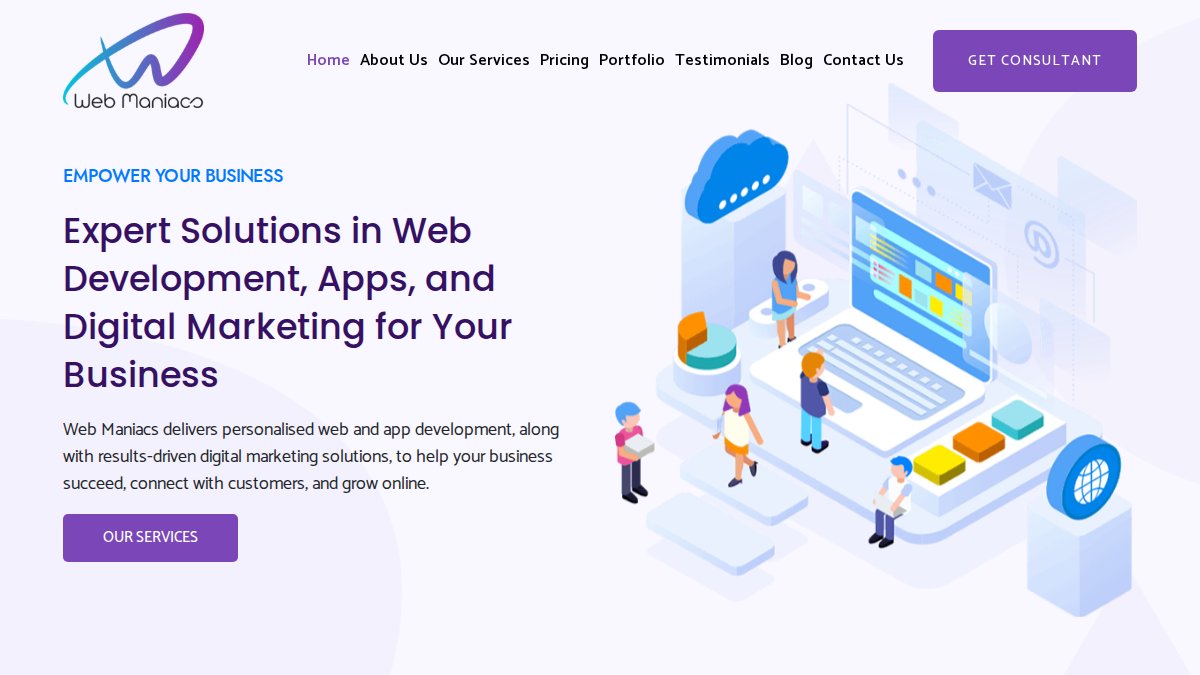
Web Maniacs is the top pick for startups that need a single, accountable partner across web design, custom software development, and digital marketing. Rather than stitching together a designer, developer, and SEO agency, you get personalised web and app development alongside results-driven digital marketing under one roof.
What most boutique agencies miss is Google Local Optimization, which matters enormously for startups targeting a regional market before scaling nationally. Web Maniacs builds this in from day one, alongside SEO-friendly architecture that ensures your site is built to rank, not just to look good.
Best for: Startups that want custom website development, lead generation strategy, and mobile app creation from a single partner.
Pros: Personalised service, custom software development, comprehensive Google Local Optimization, results-driven approach.
See the Web Maniacs pricing page for current packages.
Clay – Best for VC-Backed Tech Startups
Premium positioning is Clay’s entire value proposition. The agency has delivered UI/UX design and development for clients including Slack and Coinbase. For a seed-stage startup burning through runway, Clay is probably overkill. For a Series A or B company preparing for a high-profile product launch, the investment in high-fidelity prototyping, motion design, and strategic brand identity work can pay back quickly in conversion rate optimization. Early-stage bootstrapped teams will find the investment level prohibitive.
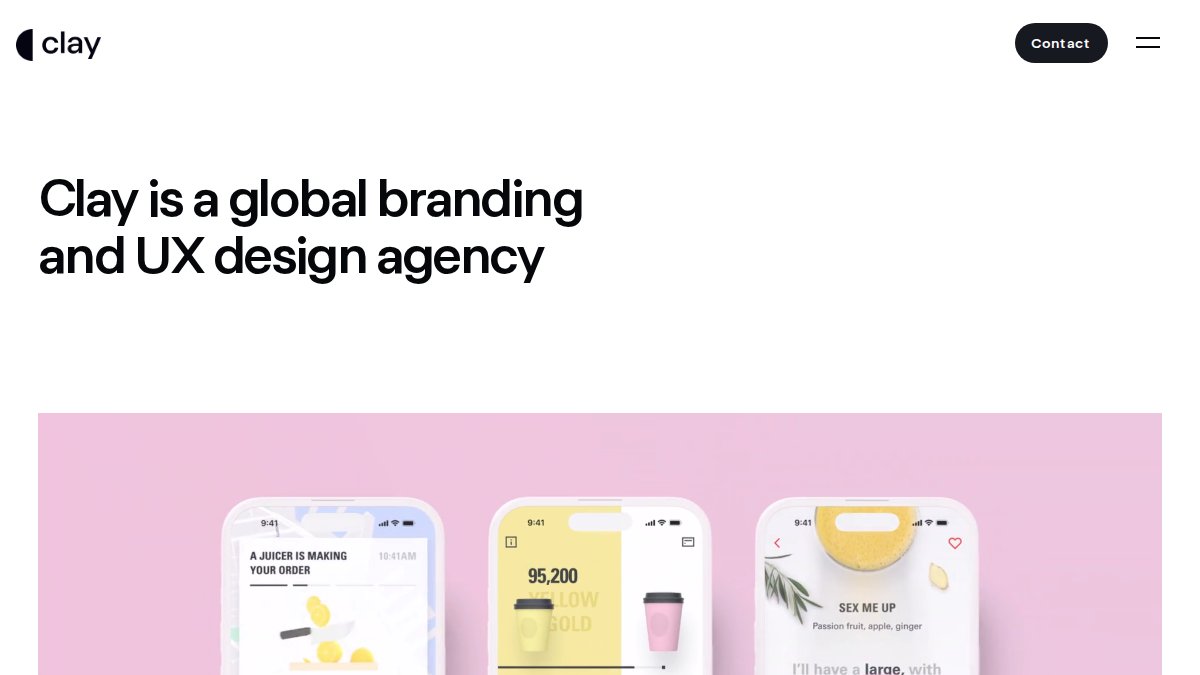
Best for: VC-backed tech startups needing product-led growth design.
Webflow – Best No-Code Platform for Design Control
Webflow is a professional-grade visual development platform that outputs clean, production-ready code, a skilled designer can build a site with cross-platform compatibility and advanced CMS integration without writing a line. The $14/month starting price is deceptive in the best way: startups get enterprise-grade hosting, a deep integration ecosystem (Zapier, Shopify, HubSpot), and responsive design capabilities that rival custom builds. The learning curve is real for non-designers, but the ceiling is high.
Best for: Startups with a designer on the team who need design flexibility without engineering overhead.
Goji Labs – Best for MVP Development
Goji Labs specialises in end-to-end product strategy, custom web and mobile application development, and iterative MVP cycles built around user-centric research. The $25,000 starting price reflects the scope: Goji handles backend development alongside UI/UX design, the combination most startups struggle to source from a single vendor. If you need a landing page, look elsewhere.
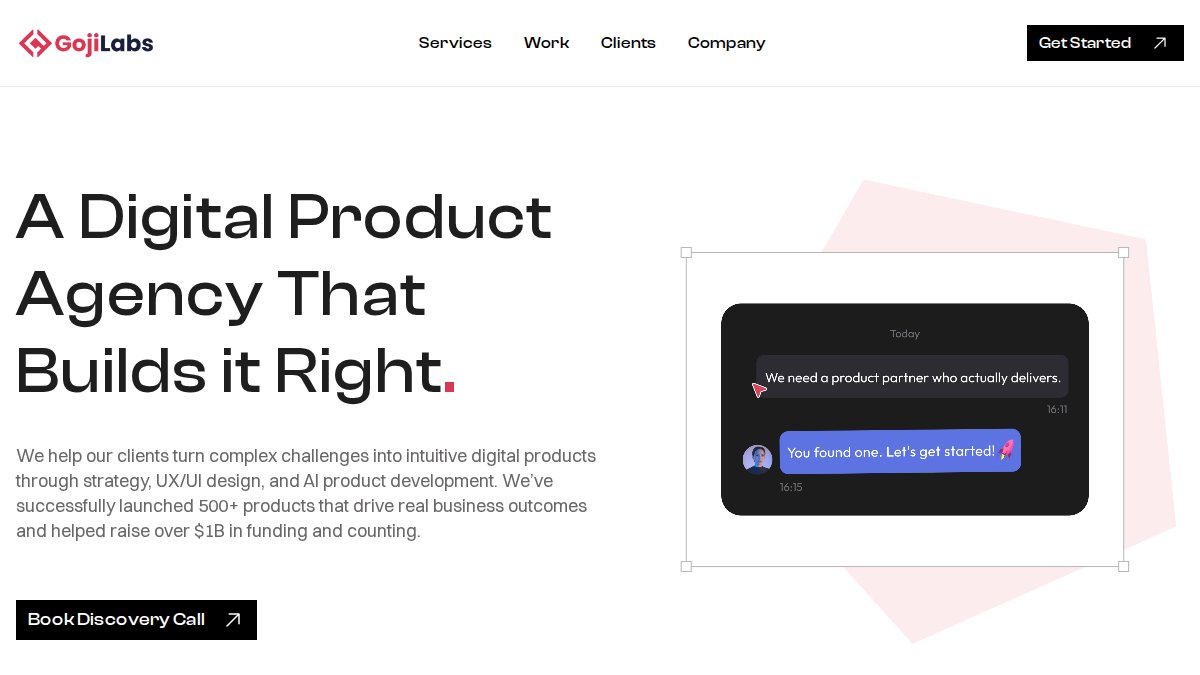
Best for: Product-led startups building their first MVP or scaling a digital product.
Blend – Best for B2B Lead Generation
Blend operates on a specific thesis: B2B tech startup websites fail not because they look bad, but because they aren’t architected for pipeline generation. The agency builds conversion-focused design strategy and B2B-specific lead generation architecture from the ground up, with an SEO-first development approach on every project. The £30,000 entry point targets growth-stage companies that need credibility and qualified leads. If your sales cycle is complex and your buyer is a procurement committee, this specialisation is worth the premium.
Best for: B2B tech startups prioritising pipeline and credibility over aesthetic experimentation.
Squarespace & Framer – Best for Early-Stage Speed
Both platforms solve the same problem from different angles: getting a professional site live before your runway runs out.
Squarespace at $16/month gives non-technical founders award-winning templates, integrated e-commerce, built-in SEO tools, and managed hosting. Customisation hits a ceiling quickly if your brand requires something beyond the template grid. Framer at $5/month is the better choice for design-heavy startups, its Figma-like workflow produces highly interactive marketing sites with superior animation capabilities, though it’s less suitable for complex web applications or large-scale e-commerce.
The practical rule: Use Squarespace if your founder is non-technical and needs something live this week. Use Framer if you have a designer and want a site that stands out visually.
Custom vs Template Website for Startups: Which Should You Choose?
The right choice depends on your stage, not your ambition. A template-based site on Webflow, Squarespace, or Framer is the correct call at pre-seed and early seed stage. Modern templates support CMS integration, responsive design, and basic conversion rate optimization without a custom build, they are not the static products they were five years ago.
Custom website development makes sense when your product requires functionality no template can replicate, when brand identity is a competitive differentiator, or when you are building a web application rather than a marketing site. The mistake most startups make is commissioning a fully custom build before validating their offer. A custom site takes longer, costs more, and requires ongoing technical maintenance, at pre-seed, when messaging is still evolving, it can become a liability.
No-Code vs Custom Development: ROI Considerations
No-code platforms deliver faster time-to-market and lower upfront cost, but the ROI calculation changes as you scale. Custom development offers greater flexibility and long-term scalability at higher initial and maintenance cost.
- Use no-code if: Your site is primarily a marketing and lead generation tool, you have fewer than 10 custom functional requirements, and you expect significant messaging changes in the next 12 months.
- Use custom development if: Your site IS your product, you need complex authentication or custom user journey mapping, or you’re preparing for a high-traffic launch requiring specific performance infrastructure.
According to Webflow’s platform documentation and use case library, many growth-stage startups use no-code platforms to launch and validate, then migrate to custom builds after product-market fit, a sound approach that conserves capital when it matters most.
Build your first version on a no-code platform, but architect your content and CMS structure as if you will migrate to a custom build later. Clean content models make that migration far less painful.
Web Design Pricing for Startups: What to Budget in 2026
| Tier | Price Range | What You Get |
|---|---|---|
| DIY platforms (Squarespace, Framer) | $5-$25/month | Templates, managed hosting, basic CMS |
| Freelancer or small studio | $3,000-$15,000 | Custom design, limited development |
| Boutique agency (Webflow-based) | $15,000-$40,000 | Custom design, CMS, SEO-friendly architecture |
| Full-service agency (Web Maniacs, Blend) | $30,000+ | Strategy, design, development, marketing integration |
| Premium product agency (Clay, Goji Labs) | $25,000-$100,000+ | End-to-end product design and engineering |
Hourly rates typically range from $100 to $250 for mid-tier agencies; project-based pricing is generally more predictable for startups with a defined scope. Match your investment to your stage, a pre-revenue startup spending $80,000 on a custom website before validating their offer is a common and expensive mistake.
Startup-Specific ROI Metrics to Track After Launch
Track these after any web design project:
- Conversion rate by traffic source: If paid traffic converts at under half the rate of direct traffic, your landing page is not doing its job.
- Time on page vs. bounce rate by device: A high mobile bounce rate often signals a responsive design failure, not a traffic quality problem.
- Lead-to-MQL rate: For B2B startups, track the downstream quality of form submissions, not just volume.
- Page speed scores: According to Google’s Core Web Vitals documentation, page experience signals directly influence search ranking.
- Organic keyword ranking movement: An SEO-friendly architecture should produce measurable ranking improvements within 90 days of launch.
Do not accept a web design project handoff without a documented baseline of these metrics. Without a pre-launch benchmark, you cannot attribute improvements to the design investment, and you lose your negotiating position if performance underdelivers.
Startup Website Design Best Practices That Drive Results
The gap between a startup site that generates leads and one that just exists comes down to a small number of decisions made early in the design process.
UI/UX Design and User Journey Mapping
UI/UX design structures how users move through your site to reach a desired action, for startups, almost always a signup, demo request, or sales conversation. User journey mapping identifies every touchpoint between a visitor’s first click and that conversion event, then removes friction from each step.
A common mistake is designing for the homepage as the primary entry point. For most startups with SEO or paid traffic, a significant portion of visitors land on interior pages. Each page needs to function as a standalone conversion surface. Practical principles that consistently move conversion rates:
- Place your primary CTA above the fold on every key page
- Use social proof (client logos, testimonials) within the first scroll depth
- Reduce navigation options on landing pages to minimise exit paths
- Design mobile-first, then adapt to desktop (not the reverse)
SEO-Friendly Architecture and Conversion Rate Optimization
SEO-friendly architecture is the structural foundation that allows search engines to crawl, index, and rank your content, clean URL structures, proper heading hierarchy, fast load times, and schema markup from day one. CRO and SEO are not competing priorities: a site built with clear information architecture and fast load times performs better in both dimensions. As noted in Moz’s guide to technical SEO fundamentals, technical site health is a prerequisite for any content or link-building strategy to take effect.
Brief your web design agency on your target keywords before the site architecture is finalised. Retrofitting SEO onto a site built without it is significantly more expensive than building it in from the start.
Web Design Timeline for Startups: How Long Will It Take?
Realistic benchmarks by project type:
- No-code platform (DIY): 1-2 weeks for a polished site with a good template
- Freelancer or small studio: 4-8 weeks for a custom design with basic development
- Boutique agency (Webflow-based): 6-12 weeks for strategy, design, and build
- Full-service agency: 10-16 weeks for strategy, custom development, and marketing integration
- MVP development (Goji Labs model): 12-20 weeks depending on product complexity
The single biggest cause of timeline overruns is delayed feedback and approval cycles on the client side. Agencies typically build in 2-3 rounds of revisions, when those rounds stretch from days to weeks, every subsequent phase shifts. Appoint one decision-maker internally before the project starts.
For most early-stage startups, a no-code site built well beats a custom site built slowly. A site live in three weeks and iterated based on real user data will outperform a perfect site delivered in six months.
How to Choose the Best Web Design Service for Your Startup
Selecting the right web design partner is a vendor vetting exercise, not a beauty contest. The agencies with the most impressive portfolios are not always the right fit for your stage, budget, or technical requirements.

Use this checklist before signing any contract:
- Does the agency have case studies from companies at your stage (not just enterprise clients)?
- Can they demonstrate SEO-friendly architecture in their previous work?
- What is their project management methodology (agile, waterfall, hybrid)?
- Who is your day-to-day contact, and what are their qualifications?
- What does the post-launch support package include?
- Do they have experience with your industry or a comparable one?
- What are their hourly rates for change requests outside the original scope?
- Can they provide client testimonials from founders, not just marketing managers?
According to Nielsen Norman Group’s research on digital agency selection, the quality of project management and communication processes is a stronger predictor of client satisfaction than the quality of the agency’s portfolio. The question most founders forget to ask is about post-launch support, a site with no maintenance plan will degrade in performance, security, and search ranking within months.
Post-Launch Maintenance and Scaling: What Agencies Won’t Tell You
A website is not a finished product. It is a living system that requires ongoing maintenance, performance monitoring, and iterative improvement.
What post-launch maintenance actually involves:
- Security updates and CMS patches: Outdated plugins and CMS versions are the primary attack vector for site compromises. Monthly maintenance is not optional.
- Performance monitoring: Page speed degrades as you add content, integrations, and third-party scripts. Quarterly performance audits keep Core Web Vitals in acceptable ranges.
- Content updates and A/B testing: The first version of your site will not be the best-converting version. Budget for ongoing CRO work, not just a one-time build.
- Scaling infrastructure: Confirm your hosting infrastructure can handle traffic spikes before running paid campaigns or a PR push.
Budget for maintenance at roughly 15-20% of your initial build cost annually. If an agency tells you the site is "done" at launch, treat that as a red flag. A full-service digital agency like Web Maniacs includes ongoing support as part of its engagement model, covering custom software development updates, SEO monitoring, and digital marketing strategy adjustments as your startup grows.
Frequently Asked Questions
How much should a startup spend on web design?
Web design pricing for startups varies widely based on scope. Template-based platforms like Webflow or Squarespace start from as little as $14-$16 per month, while boutique agencies like Goji Labs start around $25,000 and full-service firms like Blend or Digital Silk begin at $30,000+. A practical rule for early-stage startups is to match spend to your current growth stage, invest in custom development only when your business model is validated and you need scalability.
Do startups need custom web design or website templates?
It depends on your stage. Early-stage startups benefit from template-based platforms like Squarespace or Framer for speed and low cost. As you scale, custom website development offers better SEO-friendly architecture, CMS integration, and cross-platform compatibility. The key question is whether your website is a core product differentiator or a supporting marketing channel, if it's the former, custom development is worth the investment.
How long does it take to build a website for a startup?
The web design timeline for startups depends on complexity. A template-based site using no-code tools can go live in one to two weeks. A custom marketing site from a boutique studio typically takes four to eight weeks. A full MVP or web application with custom software development can take three to six months. Using agile methodology with iterative sprints can compress timelines significantly, especially for startups that need to move fast.
What should a startup look for in a web design agency?
When vetting the best web design services for startups, prioritise agencies with startup-friendly pricing, proven UI/UX design expertise, and a portfolio that includes growth-stage companies. Look for transparent project management processes, responsiveness, and experience with responsive design and conversion rate optimization. Client testimonials and case studies are strong trust signals. Also confirm whether they offer post-launch support, many agencies hand off the site without ongoing maintenance options.
Is it better to hire a freelancer or an agency for startup web design?
Freelancers are often more budget-conscious and flexible, making them suitable for simple landing pages or early-stage MVP sites. However, a full-service digital agency brings broader technical expertise, covering brand identity, digital marketing strategy, mobile app development, and CMS integration under one roof. For startups that anticipate scaling quickly or need data-driven strategies from day one, an agency typically delivers more consistent results and accountability.
Startup websites fail most often not because of bad design, but because of misaligned expectations between what a site can do and what it was built to do. Web Maniacs addresses this by combining personalised web and app development with results-driven digital marketing strategy, so your site is built to generate leads and increase online visibility from day one, not just to satisfy a launch deadline. Get started with Web Maniacs and build a digital foundation that scales with your startup.
This article was written using GrandRanker