What’s in a Small Business Branding Package
Table of Contents
- What Is a Branding Package?
- Core Components of a Branding Package
- Essential Brand Assets for Startups
- Brand Style Guide Examples and Implementation
- How Long Does Branding Take?
- Branding Package Pricing Guide
- Why Small Businesses Need Professional Branding
- Post-Delivery Asset Management and Scalability
Last Updated: August 12, 2026
What Is a Branding Package?
A branding package is a comprehensive collection of visual identity and strategic assets designed to establish how a business presents itself to the world. It includes everything from your logo and colour palette to typography standards and brand guidelines that dictate how these elements should be used across different media.
A professional package includes dozens of assets and specifications that work together to create a cohesive visual language. This consistency builds trust and makes your business look established, even if you’re just starting out. When every touchpoint, your email signature, social media headers, packaging, and website, reflects the same visual identity, customers recognize your brand instantly, creating your competitive advantage.
Core Components of a Branding Package
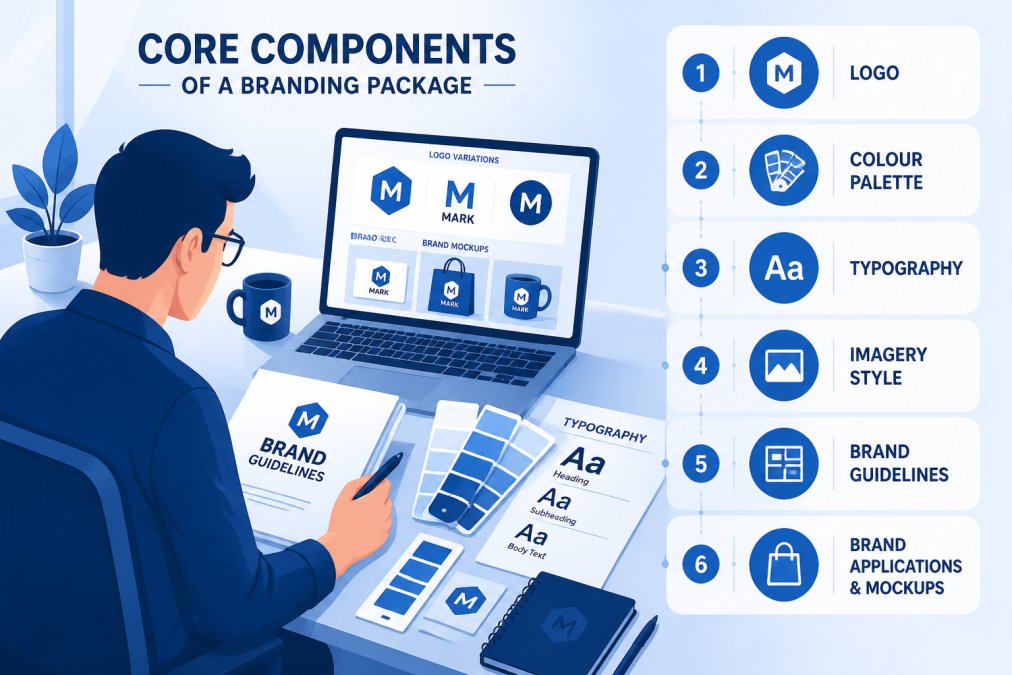
A complete branding package typically includes several interconnected elements that work together as a unified system.
Logo Design and Variations
Your logo is the visual anchor of your entire brand identity. A professional branding package includes multiple variations designed for different applications: a primary logo (the full version), a simplified version for small spaces, and a favicon for your website browser tab. Each maintains the same core visual identity while adapting to its specific use case.
You’ll receive files in multiple formats: vector files (for scaling without quality loss), raster files (for web use), and often a watermark version for protecting your brand assets online. Professional packages specify exactly where your logo can and cannot be placed, how much space must surround it, and what backgrounds work best.
Colour Palette and Typography
Your colour palette defines the emotional tone of your brand. A professional branding package specifies exact colours using hex codes (for digital use), Pantone numbers (for print), and RGB values. Typically, you’ll have a primary colour, secondary colours, and accent colours, each serving a specific purpose in your visual hierarchy.
Typography is equally important. Your branding package specifies which fonts to use for headlines, body text, and special applications, including font sizes, line spacing, and when to use bold or italics. This creates visual order that makes your content easier to scan and digest.
Essential Brand Assets for Startups
Beyond the core visual elements, a comprehensive branding package includes practical assets you’ll use immediately. Business cards specify exact layout, colours, typography, and spacing. Email templates maintain brand consistency in frequent customer touchpoints. Social media templates ensure consistency across platforms with profile headers, post backgrounds, and story graphics.
Your branding package also includes guidelines for digital and print collateral, from website design specifications to letterhead layouts, invoice templates, and presentation decks. No matter what medium someone encounters your brand through, it should feel like the same business.
Brand Style Guide Examples and Implementation
A brand style guide is the instruction manual for your entire visual identity. It documents every decision about how your brand should look and feel, ensuring consistency whether you’re designing a new website or creating social media content years from now.
Your style guide begins with your brand story, a brief explanation of who you are and why it matters. It includes detailed documentation of your logo with examples of misuse to avoid. The colour section provides hex codes, RGB values, and Pantone numbers for every colour, explaining when to use each and why.
Typography guidelines specify which fonts to use for different applications, their sizes, line heights, and letter spacing. Photography and imagery guidelines might specify that you use bright, natural lighting with real people rather than stock photos, or that images should always include your brand colours.
Implementation is where most small businesses stumble. The best style guides include practical examples showing exactly how to apply the guidelines in real situations, what a properly branded email looks like, what a social media post should include, how to structure a web page. These examples make it easy for anyone on your team to create on-brand content without needing to interpret abstract rules.
How Long Does Branding Take?
The timeline for developing a professional branding package typically follows this arc: discovery (one to two weeks), concept development (two to three weeks), refinement (two to four weeks), and final delivery (one to two weeks). Discovery is when the designer learns about your business, industry, competitors, and target audience. Concept development produces initial logo concepts and colour palettes. Refinement adjusts proportions and tests colour combinations based on your feedback. Final delivery creates all variations, exports files in correct formats, and documents everything in your style guide.
Total timeline: expect four to twelve weeks from start to finish, depending on your responsiveness to feedback and the complexity of your brand identity.
Branding Package Pricing Guide
Branding package costs depend on the designer’s experience level, the scope of assets included, the number of revision rounds, and whether you’re working with a freelancer or an agency.
Entry-level packages cover essentials: logo design with variations, a basic colour palette, font recommendations, and simple brand guidelines. Mid-range packages expand significantly with more logo variations, comprehensive colour palettes, detailed typography systems, and a thorough style guide, often including business card design, email templates, and social media templates. Premium packages are comprehensive, including extensive asset libraries, templates for every type of marketing collateral, detailed photography guidelines, illustration styles, and comprehensive brand implementation across multiple platforms.
For current pricing and to discuss what level of branding package makes sense for your specific business, visit the Web Maniacs website to explore options tailored to your needs.
Why Small Businesses Need Professional Branding
A weak or inconsistent brand identity makes your business look amateur, regardless of how good your products or services are. Customers make split-second judgments about whether to trust you based partly on how professional your visual presentation appears.
Professional branding builds credibility. When every touchpoint reflects a cohesive visual identity, customers perceive your business as established and trustworthy. Businesses that maintain uniform visual identity across all platforms see significantly higher customer recall. A professional branding package also saves money long-term, when you have clear guidelines and asset templates, creating new marketing materials becomes faster and cheaper.

Professional branding makes hiring easier too. When you bring on team members or contractors, comprehensive brand guidelines mean they can create on-brand content immediately without constant corrections.
Post-Delivery Asset Management and Scalability
Receiving your branding package is just the beginning. Organize your brand assets in a centralized location that your entire team can access. Clearly label which files are the current official versions with date and version number to prevent multiple versions floating around.
Your style guide should include practical examples showing exactly how to apply your branding to different situations. Plan for scalability from the start, as your business grows, your branding might need to expand. Your original branding package should be flexible enough to accommodate growth.
Consider creating additional brand assets as your business grows, such as illustration styles, photography guidelines, or motion graphics standards. Rather than feeling disconnected, they should extend your existing visual language. Refresh your branding periodically every three to five years, but don’t abandon it constantly, frequent changes confuse customers and waste investment.
Professional branding is one of the highest-ROI investments a small business can make. It’s the visual foundation that supports everything else you do, your marketing, your customer experience, your team’s ability to represent your business consistently. Web Maniacs specializes in creating comprehensive branding packages that give small businesses the visual identity of established companies, complete with scalable assets, detailed guidelines, and ongoing support to implement your new brand identity across all your business channels. Get started with Web Maniacs and transform how your business presents itself to the world.
Frequently Asked Questions
What should a branding package include?
A comprehensive branding package includes a professional logo with variations (horizontal, vertical, icon), a cohesive colour palette with hex codes, typography and font hierarchy guidelines, brand guidelines documenting your visual identity, business cards, email templates, social media graphics, and often a favicon and sub-logo. The exact contents depend on your package tier, but core elements cover your visual identity, brand messaging, and essential marketing collateral needed across digital and print touchpoints.
How long does branding take from start to finish?
A typical branding project takes 4 to 12 weeks, depending on complexity and revision rounds. The timeline includes brand discovery and strategy (1-2 weeks), concept design and refinement (2-3 weeks), feedback and iterations (1-2 weeks), and final asset delivery and documentation (1-2 weeks). Simpler packages for startups may complete in 4-6 weeks, whilst comprehensive rebrand projects with extensive stakeholder input can extend to 12 weeks or longer.
Do I need a brand style guide for my small business?
Yes. A brand style guide is essential for maintaining visual consistency across all your marketing channels, from your website to social media to printed materials. It documents your logo usage, colour palette, typography, tone of voice, and design principles, ensuring everyone on your team (or any contractors) applies your brand correctly. This consistency builds brand recognition and trust with your audience.
What are the essential brand assets for social media?
Essential social media assets include a profile picture (square logo or icon), a cover or banner image (sized for each platform), social media post templates, story templates, and branded graphics for recurring content. You'll also need a consistent colour palette and typography applied across posts, profile descriptions that reflect your brand voice, and email templates for newsletters. These assets ensure your brand looks professional and recognisable across every digital touchpoint.
This article was written using GrandRanker