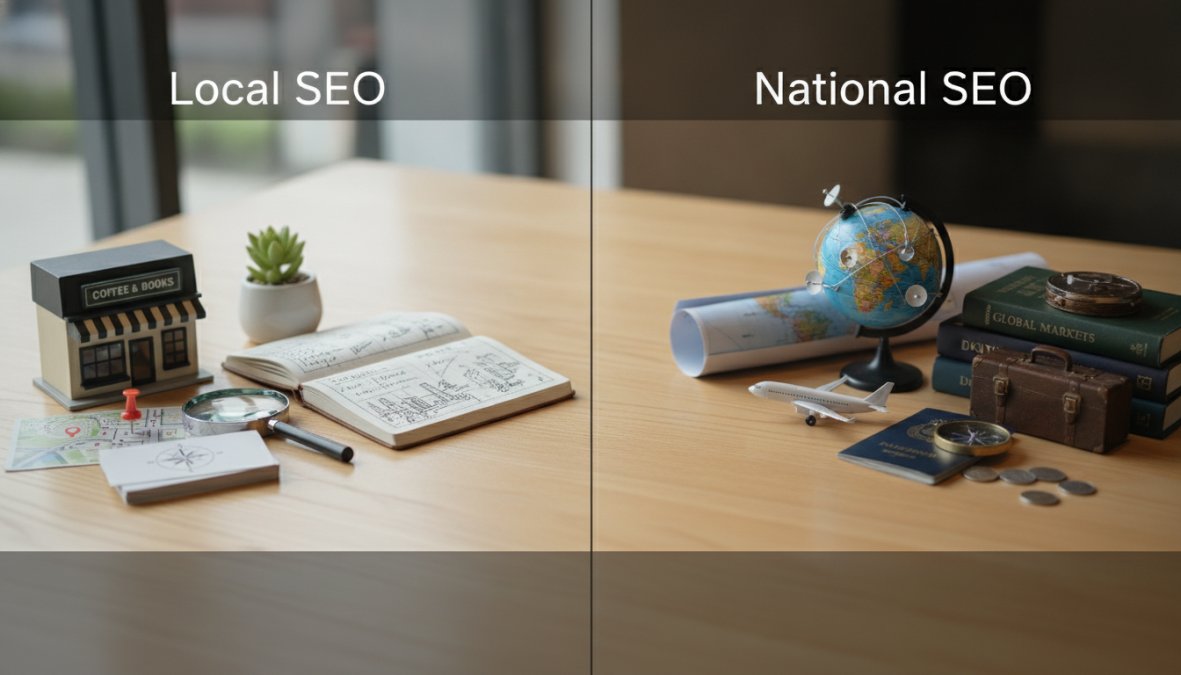
Local SEO vs National SEO for Startups: A 2026 Guide
Table of Contents
- Local SEO vs National SEO for Startups: Key Differences Explained
- Local SEO Ranking Factors That Drive Startup Growth
- How to Scale SEO From Local to National: A Startup Roadmap
- SEO Budget for Startups: Local vs National Investment
- National SEO Tools and Platforms for Startup Growth
- When to Choose Local SEO vs National SEO for Your Startup
- Common Startup SEO Mistakes to Avoid
- Conclusion: Your Startup’s SEO Path Forward
Last Updated: July 5, 2026
Local SEO vs National SEO for Startups: Key Differences Explained
Understanding the distinction between local SEO vs national SEO for startups is critical for allocating your limited marketing budget effectively. Local SEO targets customers within a specific geographic area, while national SEO targets keywords and audiences across the entire country. For a startup with limited resources, this distinction determines whether you win or lose in your market.
What Is Local SEO?
Local SEO optimizes your online presence to attract customers searching for your products or services within a specific geographic location. When someone searches "plumber near me," they’re triggering local search results. Your goal is to appear in the Google Local Pack, the three map listings at the top of search results.
Local SEO relies on four pillars: your Google Business Profile, citation consistency across business directories, local backlinks, and customer reviews. Unlike national SEO, which focuses on domain authority and broad keyword rankings, local SEO emphasizes geographic relevance and trust signals from your immediate market.
What Is National SEO?
National SEO targets search queries without geographic modifiers. When someone searches "best project management software," they’re not specifying a location. National SEO requires building domain authority, creating comprehensive content that outranks competitors nationwide, and earning backlinks from high-authority websites.
National SEO is more competitive, takes longer to show results, and demands significantly more content and technical SEO work. However, ranking nationally for high-volume keywords can drive thousands of qualified leads monthly.
Local SEO Ranking Factors That Drive Startup Growth
Local search rankings depend on specific factors that differ from national SEO: Google Business Profile optimization, NAP consistency, review volume and quality, and local citation authority.
Google Business Profile Optimization
Your Google Business Profile (GBP) is the single most important asset for local SEO. A complete, optimized profile can drive 30% more clicks than an incomplete one.
Optimization involves: use your actual business name (not keywords), select the most relevant primary category, add all service areas if location-independent, upload high-quality photos and videos regularly, respond to all reviews within 48 hours, and keep hours and contact information current. Post weekly updates about promotions, new products, or events to signal activity to Google.
Add a direct call-to-action link in your GBP description. Instead of just describing your business, include “Book now” or “Get a free quote” with a direct link. This reduces friction and increases conversion rates from local searches.
NAP Consistency and Citation Building
NAP stands for Name, Address, Phone number. Google uses NAP consistency to verify your business legitimacy. If your business name appears as "Acme Plumbing" on your website but "Acme Plumbing Services" on Yelp, Google gets confused about whether these are the same business.
Citation building means getting your business listed on relevant directories: Yelp, Apple Maps, Facebook Business, industry-specific directories, local chambers of commerce, and local review sites. Each citation acts as a vote of confidence. Start with the top 20 high-authority directories in your industry, including Google Business Profile, Yelp, Facebook, Apple Maps, Better Business Bureau, and your local chamber of commerce. Tools like BrightLocal can automate citation building and monitor consistency.
Local Pack Visibility and Review Management
The Local Pack is where most local clicks happen. To rank in the Pack, you need a complete GBP, consistent citations, and a strong review profile. Reviews serve as social proof and ranking signals simultaneously.
Encourage customers to leave reviews immediately after purchase or service completion. Respond to every review, positive and negative. Negative reviews that receive thoughtful, professional responses actually increase trust more than businesses with no negative reviews.
How to Scale SEO From Local to National: A Startup Roadmap
Smart startups follow a three-phase approach that builds on early wins and accumulates domain authority before attempting national competition.
Phase 1: Dominate Your Local Market First
In the first 3-6 months, focus exclusively on becoming the dominant local result in your area. Optimize your GBP, build 15-20 consistent citations, and accumulate 20+ reviews with an average rating above 4.5 stars. Target local long-tail keywords like "best [service] in [city]."

This phase builds momentum and early revenue. Local customers are easier to convert because proximity builds trust. You also generate case studies and testimonials that become social proof for your national expansion later.
Phase 2: Build Domain Authority and Backlink Profile
Once you’re dominating locally (typically 6-12 months in), expand your content strategy to build domain authority. Create comprehensive guides, case studies, and resource pages that attract backlinks from high-authority websites.
Develop 5-10 pillar content pieces that address core problems your customers face. Reach out to industry publications, relevant blogs, and local news outlets for backlink opportunities. A single backlink from a domain authority 50+ site is worth more than 50 links from low-authority sites.
Many startups spend 6 months building local authority, then immediately try to rank for competitive national keywords. This fails because you lack the domain authority to compete. Expect 12-18 months of content and backlink building before you see meaningful national rankings.
Phase 3: Expand to Multi-Region and National Keywords
After 12-18 months of building authority, you’re ready to target broader geographic areas and national keywords. Create content targeting multiple regions, expand your service areas, and pursue higher-volume keywords with more national intent.
This phase is where SEO budget typically increases significantly. You may hire an SEO specialist or partner with an agency.
SEO Budget for Startups: Local vs National Investment
Budget allocation depends on your chosen strategy. Local SEO requires less investment upfront but demands consistency. National SEO requires more capital but scales better as you grow.
Local SEO Budget Allocation
A lean local SEO budget for a startup allocates: 40% tools and software, 30% content creation, 20% local link building and citations, 10% review management and GBP optimization.
For a $2,000 monthly budget, allocate approximately $800 to tools (BrightLocal, Semrush’s local features), $600 to content creation (1-2 blog posts monthly), $400 to local citation building, and $200 to review management. Local SEO generates positive ROI within 3-4 months because competition is lower and customer intent is higher.
National SEO Budget Allocation
National SEO demands a larger investment: 25% tools, 40% content creation, 20% link building, 10% technical SEO, 5% analytics and reporting.
A $5,000 monthly national SEO budget allocates $1,250 to tools, $2,000 to content creation (4-6 comprehensive pieces monthly), $1,000 to link building and PR outreach, $500 to technical SEO, and $250 to analytics. National SEO ROI takes 6-12 months to materialize because you’re competing against established sites with higher domain authority.
Hybrid SEO Strategy for Resource-Constrained Startups
The hybrid approach combines local and national efforts on a modest budget. This strategy works best for startups with geographic expansion plans or service-based businesses that can scale regionally.
| Phase | Timeline | Focus | Monthly Budget | Primary Goal |
|---|---|---|---|---|
| Local dominance | Months 1-6 | Local pack, reviews, GBP | $1,500-2,500 | Establish local authority |
| Regional expansion | Months 7-12 | Multi-location pages, regional keywords | $2,500-4,000 | Expand to 2-3 regions |
| National scaling | Months 13+ | Content authority, national keywords | $4,000-6,000+ | Compete nationally |
The hybrid approach lets you test market demand locally before investing heavily in national expansion.
National SEO Tools and Platforms for Startup Growth
Choosing the right tools determines what data you can access and what optimizations you can make.
Semrush: Best for Hybrid Local-to-National Scaling
Semrush is an all-in-one platform that handles both local and national SEO equally well. It offers position tracking across geographic regions, keyword research with search volume and difficulty metrics, site audit functionality, and local business listing management.
The platform starts at $139.95 per month for the Standard plan, which includes tracking up to 5,000 keywords and 10 projects. Semrush excels at showing you exactly which keywords your competitors rank for and how their rankings have changed over time. This competitive intelligence is invaluable when planning your national expansion strategy.
Startups planning to scale from local to national within 12-18 months who want a single platform for all SEO activities.
Ahrefs: Industry-Leading for Content and Authority Building
Ahrefs is known for the most comprehensive backlink database in the industry. For startups focused on content-driven growth and building domain authority, Ahrefs provides unmatched data on competitor backlinks, organic traffic analysis, and keyword difficulty metrics.
Starting at $99 per month, Ahrefs excels at helping you understand what content your competitors rank for and which backlinks drive their authority. The Keywords Explorer tool shows accurate search volume and keyword difficulty metrics, critical for identifying high-opportunity keywords where you can realistically compete.
The trade-off is that Ahrefs has minimal local SEO tools. If your strategy is 80% national and 20% local, Ahrefs is the better choice.
BrightLocal: Specialized for Local Pack Dominance
BrightLocal is purpose-built for local SEO. It handles local rank tracking across multiple locations, citation building and monitoring, review management across platforms, and Google Business Profile audits.
Starting at $35 per month, BrightLocal is the most affordable option and the most specialized for local-focused startups. The Local Search Grid shows exactly where you rank in the Local Pack for your target keywords across multiple locations. The citation builder automates submission to 100+ directories, and the reputation manager consolidates reviews from Google, Yelp, Facebook, and other platforms into one dashboard.
Startups with 1-3 physical locations focused exclusively on local SEO for the next 12+ months.
When to Choose Local SEO vs National SEO for Your Startup
The decision between local and national SEO depends on your business model, market size, and growth timeline.
Choose Local SEO If…
You have a physical location or service area. Service-based businesses should prioritize local SEO because customer intent is geographic.
Your market is geographically constrained. If you operate in a single city or region, national rankings don’t drive customers.
You have limited budget. Local SEO delivers faster ROI and requires less investment. You can achieve meaningful results with $1,500-2,500 monthly.
You’re testing a new market. Before expanding nationally, dominate locally first to validate your business model and build domain authority.
Choose National SEO If…
You operate online without geographic constraints. SaaS products, digital services, and e-commerce businesses should target national keywords.
Your market is highly competitive and saturated locally. National expansion offers more opportunity.
You have sufficient budget and timeline. National SEO requires 12-18 months and $4,000+ monthly.
You have a scalable business model. National SEO makes sense for businesses that can handle increased volume.
Choose Both: The Hybrid Approach
Most smart startups begin with local SEO, then add national SEO as they grow. The timeline looks like: months 1-6 (local dominance), months 7-12 (regional expansion), months 13+ (national scaling). This phased approach reduces risk because you validate demand locally before investing heavily in national competition.
Common Startup SEO Mistakes to Avoid
Ignoring local SEO entirely. Many startups obsess over national rankings while ignoring their local market. Dominate locally first, then expand.
Inconsistent NAP information. If your business name, address, or phone number varies across websites and directories, Google can’t verify you’re legitimate. Audit your NAP across all directories and fix inconsistencies immediately.
Neglecting reviews. Reviews are ranking factors and conversion factors. A business with 10 reviews and a 4.8 rating outranks competitors with zero reviews.
Targeting the wrong keywords. A new startup can’t rank for "project management software" nationally. Start with long-tail keywords where you can win.
Underestimating timeline. Local SEO takes 3-6 months to show meaningful results. National SEO takes 12-18 months. Commit to at least 6 months before evaluating effectiveness.
Inconsistent content publishing. Consistency matters more than volume. Better to publish one post monthly consistently than three posts one month and nothing for six months.
Forgetting technical SEO. You can have perfect content and optimization, but if your site is slow, mobile-unfriendly, or has crawl errors, you won’t rank. Audit your site’s technical health monthly using tools like Semrush or Ahrefs.
Choosing between local SEO vs national SEO for startups is one of the most consequential decisions you’ll make. Most startups should begin with local SEO to build authority and prove their concept, then expand nationally as they grow.
If you’re building a startup that needs both a strong digital foundation and a clear SEO strategy, Web Maniacs combines custom website design with results-driven digital marketing to help you strengthen your brand identity and increase online visibility. Their team specializes in Google Local Optimization and can guide your transition from local to national as you scale.
Frequently Asked Questions
How do I know if my startup needs local or national SEO?
Assess your business model: local SEO suits service-based businesses (plumbers, dentists, salons) serving specific geographic areas. National SEO works for e-commerce, SaaS, or content-driven businesses targeting customers nationwide. Consider your target audience location, market saturation, and growth plans. Many startups benefit from a hybrid approach, dominating locally first, then scaling nationally as resources allow.
What are the main differences between local and national SEO for startups?
Local SEO focuses on geographic modifiers, Google Business Profile optimization, and local pack rankings within specific regions. National SEO emphasizes broad-match keywords, domain authority, backlink profiles, and content marketing at scale. Local SEO typically requires lower budgets and shows faster conversion rates. National SEO demands longer timelines but offers greater scalability and brand visibility across markets.
Can a startup do both local and national SEO at the same time?
Yes, through a hybrid SEO strategy. Start by optimizing for high-intent local keywords and building local pack visibility. Simultaneously, create long-tail keyword content and build backlinks targeting national search intent. This approach maximizes ROI by capturing immediate local leads while establishing domain authority for future national expansion. Tools like Semrush support both strategies within one platform.
How long does it take to see SEO results: local vs national?
Local SEO typically shows measurable results (improved local pack rankings, increased leads) within 3-6 months with consistent Google Business Profile optimization and citation building. National SEO requires 6-12 months to see significant organic search improvements due to higher competition and domain authority requirements. Startup success depends on keyword difficulty, market saturation, and technical SEO implementation quality.
Is national SEO more expensive than local SEO for startups?
Yes, generally. Local SEO budgets for startups range from $500-2,000/month for basic optimization. National SEO typically requires $2,000-5,000+/month for competitive keyword targeting, content creation, and link building. However, startup-specific budget allocation through hybrid strategies can balance costs. Platforms like Ahrefs ($99/month) and Semrush ($139.95/month) provide affordable entry points for scaling from local to national.
This article was written using GrandRanker