Local SEO Examples: Real Strategies That Drive Results
Table of Contents
- What Local SEO Actually Means in Practice
- How to Optimize Google Business Photos for Local Rankings
- Local SEO Ranking Factors That Actually Impact Visibility
- How to Get More Google Reviews and Build Social Proof
- Real Local SEO Examples from Successful Businesses
- Common Local SEO Mistakes to Avoid
- Getting Started with Your Local SEO Strategy
- Conclusion
Last Updated: August 18, 2026
What Local SEO Actually Means in Practice
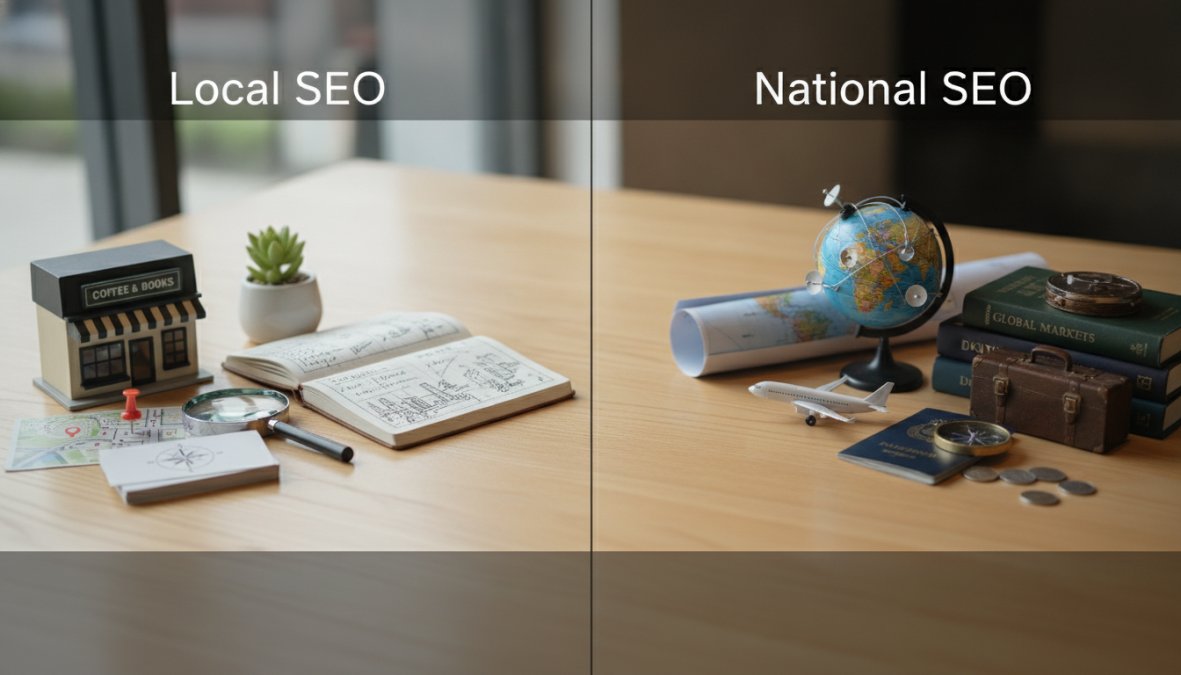
Local SEO optimises your online presence to attract customers searching for your products or services in a specific geographic area. Unlike traditional SEO, which targets a broad audience, local SEO focuses on visibility in local search results, Google Maps, and location-based queries. Local SEO captures high-intent customers actively searching for what you offer in their neighbourhood.
46% of all Google searches contain a local component, like a suburb, city, or ‘near me’ suffix Digital Applied’s 2026 local search analysis. More importantly, 97% of consumers search online before visiting a business in their area, and 80% of consumers search for local businesses every week. If you’re not optimised for local search, you’re invisible to customers already looking for you.
The three pillars of local SEO are straightforward: ensuring your business information is consistent everywhere online (NAP: Name, Address, Phone), building a strong Google Business Profile, and earning local citations and reviews that signal trust to Google. When these elements work together, you rank higher in local search results and get noticed by customers at the exact moment they’re ready to buy.
The businesses winning in local search treat their online presence as seriously as their physical storefront. The difference between ranking in position one and position five in your local area can mean the difference between a booked schedule and empty days.
How to Optimize Google Business Photos for Local Rankings
Optimising your Google Business Profile photos is one of the fastest ways to improve your local search visibility. Businesses with a complete Google Business Profile are 70% more likely to be visited in person and 2.7 times more likely to be considered reputable by potential customers.

Why Photo Count Matters
Businesses with over 100 photos on their Google Business Profile receive 42% more direction requests and 35% more website clicks than those with fewer photos. Google’s Vision AI scans and interprets photo content as a ranking signal, meaning high-quality, relevant images directly influence your local rankings. However, 30 carefully curated, high-quality photos will outperform 150 blurry, poorly lit images. The algorithm evaluates photo quality, not just count.
Best Practices for Each Photo Type
Start with your storefront or service area, well-lit, clear entrance with visible signage. Next, photograph your interior or workspace: retail businesses should show products on shelves; service businesses like salons or gyms should show treatment areas or equipment. Add product or service photos showing completed work or signature offerings, not generic stock images. Finally, add team photos and behind-the-scenes content to humanise your brand and increase trust.
Posts with fresh photos see a 23% boost in engagement within the first week. Update your profile regularly, at least once per month, to keep your business visible in local search results.
Treat your Google Business Profile like a living document. Add new photos monthly, respond to customer reviews within 48 hours, and update your business hours immediately if they change. This signals to Google that your business is active and trustworthy.
Local SEO Ranking Factors That Actually Impact Visibility
Not all ranking factors are created equal. Google’s local algorithm weighs some signals far more heavily than others.
The Three Core Ranking Pillars
Relevance is the first pillar. Google needs to understand what your business does and whether it matches what someone is searching for. A plumber optimised for "blocked drains" will rank higher for that query than one optimised for "general plumbing." Specificity wins.
Proximity is the second pillar. How close your business is to the searcher directly impacts your ranking. A café in central Auckland will rank higher for "café near me" in central Auckland than one in West Auckland, even if the West Auckland café has more reviews. You can’t change your location, but you can optimise for hyper-local keywords that match your service area.
Prominence is the third pillar. This is your online reputation: reviews, citations, backlinks, and overall authority. A business with 200 five-star reviews will outrank one with 20 reviews, all else being equal. Prominence is built over time through consistent, excellent customer service and active reputation management.
According to research [on local(/local-seo-strategies-for-tradespeople-2026/) search behaviour | shnoco.com], 76% of near-me mobile searches result in a physical store visit within 24 hours, and 28% of those visits result in a purchase. That conversion rate is significantly higher than most digital marketing channels.
Many businesses focus exclusively on getting reviews and ignore NAP consistency. If your business information is inconsistent across Google, your local directory listings, and your website, Google can’t confidently rank you. Before investing heavily in reviews, audit your NAP data across at least 10 major directories. Inconsistencies will tank your rankings regardless of review count.
How to Get More Google Reviews and Build Social Proof
Reviews are the currency of local search. They influence rankings, build trust, and directly impact whether someone clicks on your business or your competitor’s. 97% of consumers read reviews online, and 41% always read reviews when browsing for businesses.
Converting Happy Customers into Reviewers
The biggest mistake businesses make is waiting passively for reviews. Most customers never think to leave a review unless you ask them.
After every positive customer interaction, ask for a review. This works best at the point of transaction, when the customer is happiest. Make it easy by providing a direct link to your Google Business Profile review page instead of asking customers to search for your business. Text it, email it, or print it on your receipt.
Ask within 24 hours of the interaction while the experience is fresh. Respond to every review, positive and negative. This shows Google that your business is active and engaged, which boosts your ranking.
Create a simple system: after every customer interaction, send an email or text with a direct link to your Google review page. Include a sentence like, “If you had a great experience, we’d love a review, it helps us reach more customers like you.” Customers respond better to this framing than generic requests.
Real Local SEO Examples from Successful Businesses
Theory is useful, but examples show what actually works.

Example 1: Christchurch Service Business Driving Foot Traffic
A Christchurch-based service business conducted a comprehensive audit of their website and competitors, then developed a strategy based on highly searched keyword categories. They implemented on-page optimisation, technical SEO, and off-page tactics including local citations and backlinks from relevant local directories.
The result: 63% growth in organic traffic and 96% growth in organic leads year-on-year within six months. They captured customers searching for the specific services they offered, not just their business name.
Example 2: Multi-Location Retailer Ranking Across Regions
A retailer with locations across multiple cities used hyper-local SEO strategy. They conducted keyword research by city (e.g., ‘American cars Auckland’, ‘Ford Mustang Christchurch’), created optimised landing pages for each city, and built quality local links from community sites and local business directories.
Within 90 days, they ranked over 1,000 keywords on Google, with 50+ keywords on page one. They achieved a 3X increase in organic web traffic and a 2.5X increase in lead inquiries.
Example 3: Trade Business Using Local Keywords to Generate Leads
A trade business focused on local keyword research and created location-specific landing pages. They optimised their Google Business Profile with detailed descriptions of their service areas and added high-quality photos of completed work. They also built citations in local trade directories and encouraged past customers to leave reviews.
The result: consistent lead generation from local search, with customers specifically mentioning they found the business through Google Maps or local search results.
These examples share a common thread: they combined multiple tactics rather than relying on a single approach.
Common Local SEO Mistakes to Avoid
Understanding what works is half the battle. Knowing what doesn’t work helps you avoid wasting time and resources.
Inconsistent business information is the biggest mistake. If your business name is listed as "John’s Plumbing" on Google, "Johns Plumbing" on your website, and "John Plumbing Services" on local directories, Google can’t confidently match these listings. Audit your NAP data across all platforms and ensure consistency everywhere.
Ignoring Google Business Profile updates is equally damaging. Businesses that post regularly, upload new photos monthly, and respond to reviews rank significantly higher than those that don’t.
Chasing high-volume keywords instead of local intent keywords is another common mistake. A plumber ranking for "plumbing" nationally is useless if they only serve one suburb. Focus on "plumber in [suburb]" or "[suburb] emergency plumbing".
Not building local citations limits your visibility. Each citation signals to Google that your business is real and established. Businesses without citations rank lower than those with 20+ citations across relevant directories.
Neglecting mobile optimisation is critical. Over 60% of all internet searches are on mobile devices. If your website isn’t mobile-friendly, you’ll lose customers and rankings.
Responding poorly (or not at all) to negative reviews damages trust and rankings. A thoughtful, professional response shows potential customers that you care about service quality.
Getting Started with Your Local SEO Strategy
If you’re new to local SEO, the path forward is straightforward.
Step one: Claim and optimise your Google Business Profile. This is non-negotiable. If you don’t have one, create it immediately at business.google.com. Ensure your business category is accurate, your description is detailed and keyword-rich, your hours are correct, and your photos are high-quality and recent.
Step two: Audit your NAP consistency. Search for your business name online and check how your information appears across Google, local directories, your website, and social media. Fix any inconsistencies immediately.
Step three: Build a review generation system. Ask satisfied customers for reviews systematically. Make it easy by providing direct links. Respond to every review within 48 hours.
Step four: Conduct local keyword research. Identify the keywords your customers actually use when searching for your business. Create content and landing pages optimised for these keywords.
Step five: Build local citations. Submit your business to major directories relevant to your industry and location. This builds authority and ensures your information is consistent across the web.
If you’re managing this in-house and feeling overwhelmed, consider partnering with a specialist. Web Maniacs provides comprehensive Google Local Optimisation services, including Google Business Profile strategy, local keyword research, citation building, and review management.
| Local SEO Task | Frequency | Expected Impact |
|---|---|---|
| Update Google Business Profile photos | Monthly | 42% more direction requests |
| Respond to reviews | Within 48 hours | Higher rankings, increased trust |
| Audit NAP consistency | Quarterly | Prevents ranking drops |
| Add new local citations | Quarterly | Increased authority and visibility |
| Publish location-specific content | Monthly | Better rankings for local keywords |
Local SEO isn’t complicated, but it does require consistent effort. The businesses winning in local search treat their online presence as seriously as their physical storefront. They keep their information updated, ask for reviews, post regularly, and optimise for the customers actually searching for them in their area. Start with your Google Business Profile and work outward. The fundamentals work.
Frequently Asked Questions
Can you give me a concrete example of local SEO in action?
A plumber in Christchurch optimises their Google Business Profile with service area information, adds 80+ high-quality photos of completed work, collects 45 reviews with 4.8 stars, and targets keywords like 'emergency plumber Christchurch' and 'burst pipe repair near me'. Within 6 months, they rank in the local 3-pack for 12+ location-based keywords, receive 40+ qualified leads monthly, and see 76% of near-me searchers visit within 24 hours. This combines all core local SEO ranking factors: relevance, proximity, and prominence.
What are the most important local SEO ranking factors I should focus on?
Google weighs three main factors: relevance (how well your content matches local search intent), proximity (your distance from the searcher), and prominence (your reviews, citations, and backlink profile). NAP consistency across all directories, a complete and updated Google Business Profile, and a strong review count with positive ratings directly influence rankings. Businesses in the local 3-pack receive 126% more traffic than those ranked four through ten, making these factors critical for visibility.
How many Google Business Profile photos do I actually need to rank higher?
Businesses with over 100 photos receive 42% more direction requests and 35% more website clicks than those with fewer photos. Google's Vision AI now scans photo content as a ranking signal. Start with at least 50 photos covering your storefront, interior, products or services, team, and customer interactions. Quality matters more than quantity, clear, well-lit images of your actual business outperform generic stock photos every time.
How long does it take to see results from local SEO efforts?
Progress typically appears in stages. Impressions and query coverage improve first (4-8 weeks), followed by click increases (8-12 weeks), and finally lead or revenue impact (12+ weeks). A Christchurch business that implemented comprehensive local SEO saw 63% organic traffic growth and 96% organic lead growth within 6 months. Consistent effort on Google Business Profile updates, reviews, and local citations accelerates results, but sustainable local SEO is a 3-6 month investment minimum.
This article was written using GrandRanker