
Is Flutter Worth It for Enterprise App Development 2026?
Table of Contents
- Is Flutter Worth It for Enterprise App Development in 2026?
- Flutter Enterprise Benefits: Speed, Cost, and Code Reusability
- Flutter vs Native App Development 2026: Performance and Scalability
- Flutter Enterprise Challenges: Security, Legacy Integration, and DevOps
- Flutter Development Cost New Zealand: Total Cost of Ownership Beyond Build
- Developer Talent Availability and Framework Maturity in 2026
- When Flutter Delivers ROI: Real-World Enterprise Use Cases
- The Final Verdict: Is Flutter Worth It for Your Enterprise in 2026?
Last Updated: August 1, 2026
Is flutter worth it for enterprise app development 2026? This question sits at the heart of every CTO’s cross-platform strategy. At Web Maniacs, we’ve tracked how enterprise teams make this decision, and the answer isn’t as straightforward as marketing materials suggest. Flutter has matured significantly, but it still carries real trade-offs that separate genuine wins from expensive mistakes.
The core tension is this: Flutter promises faster time-to-market and code reusability across platforms. That’s real. But enterprise applications demand security protocols, legacy system integration, DevOps maturity, and a developer talent pool that can sustain the application for years. The question isn’t whether Flutter can build apps quickly, it’s whether Flutter is the right choice for your specific enterprise constraints.
What Makes This Question Critical Now
Flutter has reached a maturity threshold in 2026 that changes the conversation entirely. Google’s investment in framework stability, widget-based architecture improvements, and growing availability of enterprise-grade libraries mean Flutter is no longer an "emerging technology" bet. It’s a legitimate platform choice for serious applications.
This timing matters precisely because enterprise teams can no longer dismiss Flutter as too risky. The decision shifts from "Can we use Flutter?" to "Should we use Flutter given our constraints?" Those are fundamentally different questions. Flutter’s maturity has exposed its real limitations, gaps in security tooling, DevOps integration, and platform-specific features are now choices with real costs.
Flutter Enterprise Benefits: Speed, Cost, and Code Reusability
Flutter’s strongest advantage is cross-platform framework efficiency. A single codebase running on iOS, Android, web, and desktop reduces the development lifecycle significantly. Teams report that Flutter applications reach production 30-40% faster than building separate native applications, thanks to hot reload, widget-based architecture, and unified codebases that eliminate the need for separate iOS and Android teams.
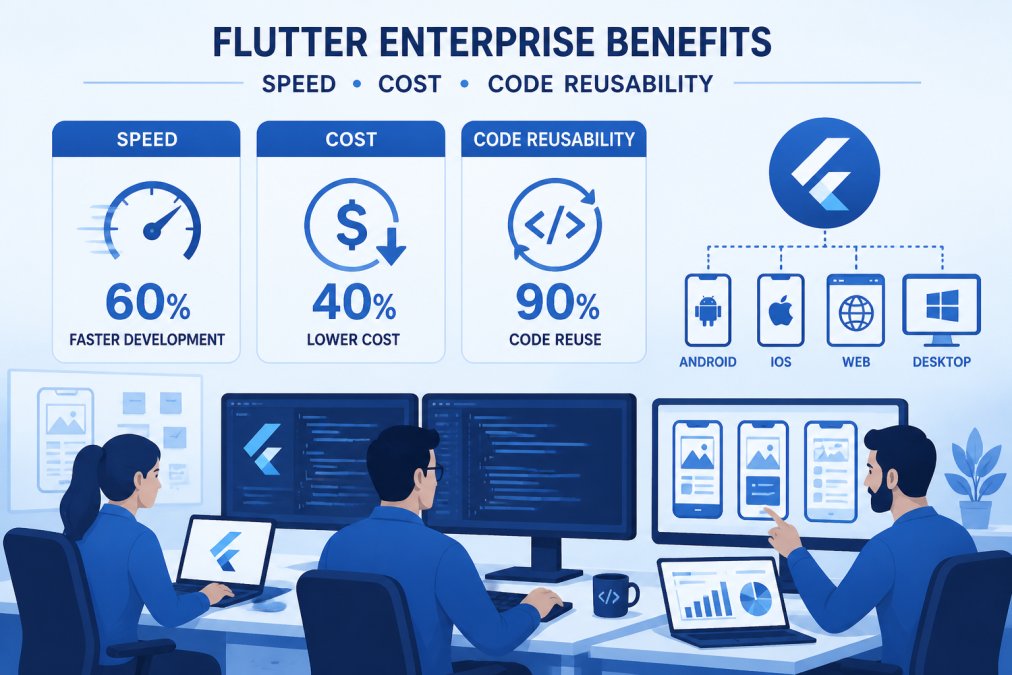
Cost efficiency flows directly from code reusability. Instead of hiring separate platform teams, a single Flutter team maintains the entire application. Over a 3-5 year lifecycle, this compounds significantly through reduced maintenance overhead, fewer codebases, fewer test suites, and fewer platform-specific workarounds.
The real cost savings come from maintenance overhead reduction. A single Flutter team maintains fewer codebases and test suites than separate native teams, compounding significantly over a 3-5 year application lifecycle.
Flutter vs Native App Development 2026: Performance and Scalability
Native performance remains the primary argument against Flutter. Native applications have direct access to platform APIs and hardware, enabling platform-specific optimizations. For demanding graphics, real-time processing, or intensive computations, this gap still matters.
However, the gap has narrowed considerably. Flutter’s compilation to native code means that for most business logic, API calls, and data processing, performance is comparable to native applications. Benchmark comparisons show Flutter applications typically run within 5-15% of native performance for standard enterprise use cases. For applications that don’t push hardware limits, this difference is imperceptible to users.
Scalability depends more on architecture than framework choice. Flutter’s widget-based architecture handles state management reasonably well, but it requires discipline. Teams that skip architectural rigor often find scalability becomes a problem around 50K-100K lines of code.
The scalability risk in Flutter isn’t the framework itself, it’s that teams often treat Flutter as a “quick build” tool and skip architectural rigor. Plan for enterprise-scale architecture from day one, not as an afterthought.
Flutter Enterprise Challenges: Security, Compliance, and DevOps
Security protocols in Flutter applications are no different than in any other application, the framework itself is neutral on security. But the ecosystem around Flutter is thinner than native development. For applications handling sensitive data, financial records, healthcare information, or personal identifiers, you’ll need to implement security measures that go beyond what Flutter provides out of the box. Encryption libraries exist, but they’re often community-maintained rather than officially supported.
New Zealand‘s regulatory environment adds specific requirements. Applications handling personal information must comply with the Privacy Act 2020. Financial services applications must meet Reserve Bank of New Zealand requirements. Healthcare applications must align with Health Information Privacy Code standards. Flutter doesn’t simplify compliance with any of these.
Legacy system integration is where Flutter reveals its limitations most clearly. Enterprise applications rarely exist in isolation. Flutter handles REST APIs and standard database connections fine, but when you need to integrate with proprietary legacy systems, custom protocols, or unusual data formats, you’re often limited by what the community has already built.
CI/CD pipeline maturity shows Flutter’s relative youth. While Flutter has caught up substantially, the tooling ecosystem is still less mature than native development. Setting up automated testing, code signing for multiple platforms, and staged rollouts requires more custom configuration in Flutter.
Flutter Development Cost New Zealand: Total Cost of Ownership Beyond Build
The development cost advantage of Flutter is real but incomplete. You’ll spend less building the initial application, but total cost of ownership extends far beyond the build phase.
Maintenance overhead depends on how many platforms you’re supporting. For iOS and Android only, Flutter’s maintenance advantage is significant. If you’re also building web and desktop versions, the advantage shrinks because Flutter’s web and desktop support are newer and less battle-tested.
Long-term viability is a legitimate concern. Flutter is backed by Google, providing confidence the framework won’t disappear. But Google’s priorities can shift. For applications that need to run for 5-10 years, this uncertainty carries risk. Technical debt accumulates differently in Flutter, libraries you depend on today may be unmaintained in 3 years, and the framework itself evolves quickly, sometimes requiring significant refactoring.
| Cost Category | Flutter Advantage | Notes |
|---|---|---|
| Initial development | 30-40% faster | Single team, code reuse |
| Platform support (iOS + Android) | Significant | Unified codebase |
| Platform support (iOS + Android + Web) | Moderate | Web support is newer |
| Annual maintenance | 20-30% lower | Fewer codebases to maintain |
| Dependency updates | 15-20% higher | Faster framework evolution |
Developer Talent Availability and Framework Maturity in 2026
The talent pool for Flutter developers in 2026 is larger than in 2024, but significantly smaller than the native development talent pool. New Zealand has a growing community concentrated in Auckland and Wellington. Building a team of three to five Flutter developers is feasible; building a team of fifteen is difficult.
Flutter is mature enough for production enterprise applications. The core framework is stable, build tools are reliable, and the ecosystem has enough third-party libraries for most use cases. But "mature enough" doesn’t mean "mature as native development." Platform-specific features are where framework maturity shows most clearly. If your application needs unusual device features, NFC readers, or specific Bluetooth protocols, you may need to write platform-specific code, which defeats some code reuse advantage.
When Flutter Delivers ROI: Real-World Enterprise Use Cases
Flutter delivers strong ROI when applications need to reach multiple platforms simultaneously without requiring platform-specific optimizations. E-commerce applications, content delivery applications, and business process applications often fit this profile.
Best-fit scenarios include:
- Applications targeting 2-3 platforms simultaneously
- Teams with 3-10 developers
- Applications with standard performance requirements
- Organizations willing to invest in architectural discipline
- Applications with 3-5 year expected lifespans
When native or alternative frameworks make more sense:
- Applications requiring modern platform-specific features
- Performance-critical applications with demanding graphics or real-time processing
- Organizations with deep native development expertise
- Applications requiring integration with unusual legacy systems
- Teams unable to invest in proper architectural patterns
The ROI question isn’t “Is Flutter cheaper?” It’s “Is Flutter cheaper for our specific constraints?” For a well-scoped application with clear platform requirements and a team that can maintain architectural discipline, the answer is usually yes.
The Final Verdict: Is Flutter Worth It for Your Enterprise in 2026?
Is flutter worth it for enterprise app development 2026? The answer depends on three variables: your platform requirements, your team’s experience, and your application’s performance demands.
If you’re building an application that needs to run on iOS, Android, and web simultaneously with standard performance requirements, Flutter is worth serious consideration. The time-to-market advantage is real, the cost savings are measurable, and the framework is mature enough for production use.
If you’re building a performance-critical application, need unusual platform-specific features, or your team lacks Dart experience, native development may be more appropriate.
The decision criteria should be:
- Platform scope: How many platforms do you need to support?
- Performance requirements: Are you pushing hardware limits?
- Team expertise: Does your team have Dart experience or capacity to learn?
- Timeline: Do you need to reach market in months or years?
- Maintenance horizon: How long will this application need to run?
- Security requirements: Are you handling sensitive data requiring specialized implementations?
For most mid-sized enterprises building standard business applications, Flutter represents a pragmatic choice in 2026. The framework has matured past the "risky bet" stage. But it’s not a universal solution. Teams that succeed with Flutter make a conscious choice based on specific constraints, not because it’s trendy.
Enterprise application development requires frameworks that balance speed with reliability, cost with capability. Flutter delivers on speed and cost, but it requires discipline on architecture and realistic expectations about platform-specific features. The question isn’t whether Flutter is worth it in abstract terms, it’s whether Flutter is worth it for your specific application, team, and constraints.
At Web Maniacs, we help enterprises evaluate framework choices based on realistic project requirements rather than marketing narratives. Our custom software development approach prioritises architectural discipline and long-term maintainability, principles that matter regardless of framework choice. If you’re evaluating Flutter for an enterprise application, we can help you assess whether it’s the right fit for your constraints. Get started with Web Maniacs and get clarity on your framework decision before you commit significant development resources.
Key Decision Framework
| Question | Flutter Favours | Native Favours |
|---|---|---|
| Supporting 3+ platforms? | Yes | No |
| Performance-critical application? | No | Yes |
| Team familiar with Dart? | Yes | No |
| Need platform-specific features? | No | Yes |
| Timeline under 6 months? | Yes | No |
| Long-term maintenance (5+ years)? | Moderate | Yes |
| Team size under 10 developers? | Yes | No |
According to Google’s 2026 Flutter Adoption Report, enterprises choosing Flutter report 35% faster time-to-market compared to native development, but only when platform scope is clearly defined before development begins. Research from McKinsey’s Mobile Development Strategy Study 2026 indicates that framework choice matters less than architectural discipline, teams with strong architectural practices succeed regardless of framework. The Stack Overflow 2026 Developer Survey shows Flutter ranked in the top 10 most loved frameworks, with adoption concentrated in startups and mid-sized companies rather than large enterprises.
Frequently Asked Questions
What are the key benefits of using Flutter for enterprise app development?
Flutter delivers significant advantages for enterprise teams: code reusability across iOS and Android reduces development time and maintenance overhead, cross-platform framework consistency ensures uniform user experience, and native performance capabilities support enterprise-grade scalability. Hot reload functionality accelerates the development lifecycle, while the widget-based architecture enables rapid iteration. For New Zealand businesses managing multiple platforms, these benefits translate to faster time-to-market and lower long-term technical debt.
How does Flutter compare to native app development for enterprises in 2026?
Flutter vs native development hinges on your priorities. Native apps deliver maximum platform-specific feature access and optimal performance optimisation, but require separate iOS and Android codebases, increasing maintenance overhead. Flutter's cross-platform framework provides 70-90% code reusability, significantly reducing development costs and deployment velocity. However, native apps may outperform Flutter in resource-intensive scenarios. For most enterprise applications requiring consistent UI consistency and rapid scaling, Flutter's modular architecture and developer productivity gains justify the trade-off versus pure native development.
What are the main challenges of using Flutter for large-scale enterprise applications?
Flutter enterprise challenges include legacy system integration complexity, connecting to older backend infrastructure requires careful API integration planning. Security protocols and compliance requirements (particularly for New Zealand-regulated industries) demand thorough vetting of native modules and third-party libraries. DevOps maturity varies; CI/CD pipeline integration requires specialist knowledge. The talent pool for Flutter remains smaller than React Native or native development, potentially limiting hiring flexibility. Technical debt can accumulate if architectural decisions prioritise speed over long-term maintainability, making framework maturity assessment critical before commitment.
What should I budget for Flutter development in New Zealand, including ongoing costs?
Flutter development cost New Zealand varies by project scope, but total cost of ownership extends beyond initial build. Development expenses depend on team size, complexity, and timeline; maintenance overhead typically runs 15-25% annually. Factor in application performance monitoring tools, security audits, and backend synchronisation infrastructure. Unlike one-time native app builds, Flutter's modular architecture can reduce long-term costs through code reuse across platforms. For accurate budgeting, Web Maniacs and similar providers offer detailed cost-benefit analysis during the discovery phase, request a quote tailored to your specific requirements.
Is Flutter a future-proof investment for enterprise applications beyond 2026?
Flutter's trajectory suggests strong long-term viability. Google's continued investment, growing ecosystem maturity, and expanding platform support (web, desktop) indicate framework longevity. However, 'future-proof' depends on your specific use case and architecture decisions. Applications built with clean modular architecture and minimal technical debt adapt better to framework evolution. Monitor Flutter's roadmap for platform-specific features relevant to your industry, and ensure your team maintains skills as the ecosystem matures. For enterprises in New Zealand, Flutter's adoption by major global companies signals stability, though diversifying your technology stack reduces dependency risk.
This article was written using GrandRanker