Android & iOS App Development Company: A 2026 Review
Table of Contents
- How We Evaluate Android & iOS App Development Companies
- What to Look For in an App Development Partner
- Cross-Platform vs Native App Development: Which Is Right?
- Mobile App Development Cost NZ: What to Budget
- Key Factors in Hiring App Developers for Startups
- Security and Compliance Standards in App Development
- Comparing Top App Development Approaches
- Final Verdict: Choosing Your Development Partner
- Frequently Asked Questions
Last Updated: September 9, 2026
The global mobile application market is projected to reach USD 378 billion in 2026, according to Itransition’s 2026 mobile app statistics, yet most businesses still struggle to find a reliable android & ios mobile app development company. The challenge isn’t a shortage of providers, it’s separating genuine technical partners from shops that promise the world and deliver a generic template. A practical framework for evaluating development partners is essential for businesses across New Zealand.
A mobile app is a long-term investment. The right partner shapes your architecture, security posture, and total cost of ownership for years; the wrong one leaves you with technical debt and a rebuild bill. Below, we show you how to evaluate an android & ios mobile app development company, what to budget for a mobile app development cost NZ, and when cross-platform or native development makes sense.
How We Evaluate Android & iOS App Development Companies
We assess development partners against five weighted criteria: technical capability, communication and process transparency, security and compliance standards, post-launch support, and value relative to complexity. Their importance shifts depending on your project stage and risk tolerance.
For startups, communication and agile methodology often outweigh raw technical flair. For enterprises, documented security protocols are non-negotiable. A partner that cannot articulate its quality assurance process or show its automated testing pipeline should raise immediate concerns.
Technical capability demands evidence, not promises. Ask for case studies that show measurable outcomes, not just polished portfolios. The SynapseIndia analysis of seven real-world projects demonstrates that custom mobile app development delivers measurable ROI when teams follow disciplined engineering practices across Android and iOS platforms.
Avoid partners who cannot name their project manager or show you their deployment process. A mobile app development company that lacks a defined software development lifecycle will struggle to deliver on time and budget.
What to Look For in an App Development Partner
A qualified partner demonstrates four things from the first consultation: a clear discovery process, a realistic roadmap, a transparent pricing model, and a named technical lead. If any are missing, the engagement will likely drift.

Look for evidence of full-cycle capability: prototyping, UI/UX design, backend integration, API development, and ongoing maintenance. Many agencies excel at front-end design but outsource infrastructure work, creating coordination risk. A partner that handles cloud infrastructure and deployment internally will deliver a more cohesive product.
Communication cadence matters more than you expect. Weekly demos, a shared project management tool, and a direct line to developers beat monthly status reports. The ResearchGate qualitative study on cross-platform development highlights that communication breakdowns between vendors and clients are a leading cause of project failure in mobile development.
Ask about performance optimization. A beautiful app that crashes or lags will destroy user retention. The partner should articulate how they handle scalability testing, load balancing, and crash reporting before launch.
Request a short technical interview with the actual developers who would build your app, not just the sales team. Their answers about architecture, testing, and deployment will tell you more than any portfolio.
Cross-Platform vs Native App Development: Which Is Right?
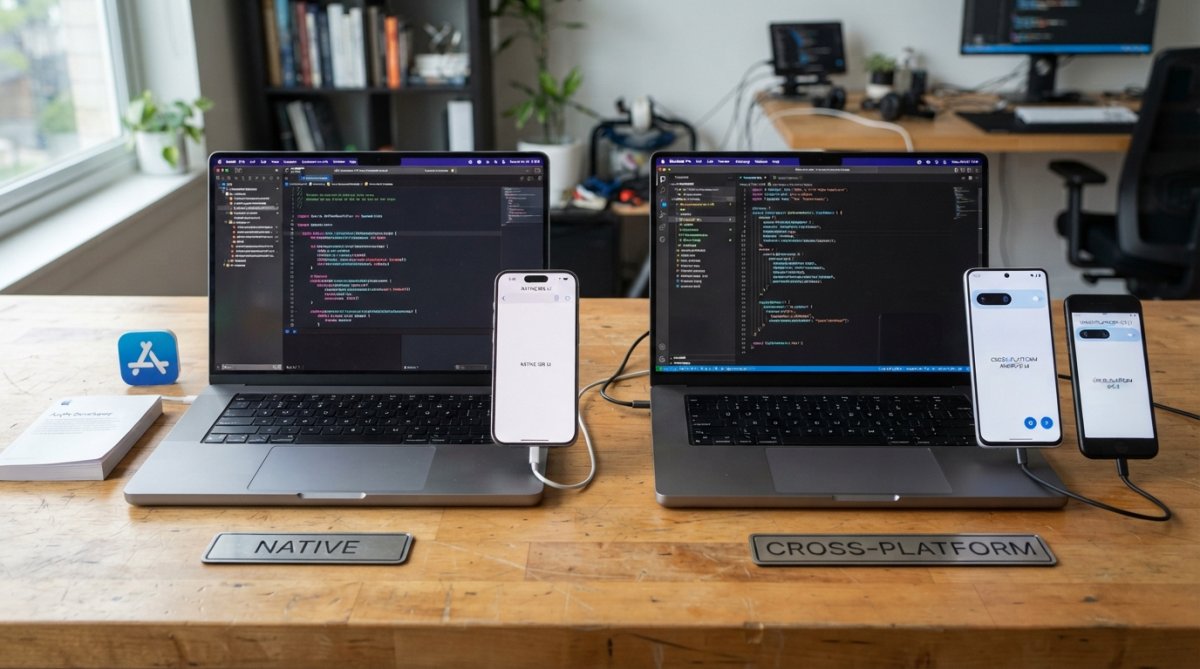
Cross-platform development uses a single codebase for both Android and iOS; native development builds separate apps in platform-specific languages like Kotlin and Swift. The choice fundamentally affects your budget, timeline, and user experience.
Cross-platform frameworks like Flutter excel when you need speed and cost efficiency. Flutter offers a single codebase, hot reload for rapid iteration, and a consistent look and feel. The tradeoff is larger app file sizes, which can affect download rates on slower connections.
Native development delivers superior performance for graphics-intensive apps, complex animations, and hardware-dependent features. Kotlin, the preferred language for native Android, offers full Java interoperability, concise syntax, and strong coroutine support. The cost is roughly double because you maintain two codebases.
The decision framework is straightforward:
- Choose cross-platform when your app is content-driven, form-based, or requires simple integrations.
- Choose native when performance benchmarks, advanced device features, or offline capability are critical.
- Choose cross-platform for your MVP, then rebuild native if user data justifies the investment.
Mobile App Development Cost NZ: What to Budget
Most cost guides stop at the initial build quote, which is a fraction of the real financial picture. For New Zealand businesses, the more important figure is Total Cost of Ownership (TCO), the sum of the build, ongoing maintenance, third-party services, and infrastructure over a typical five-year lifecycle.
Industry data from [Unico Connect’s 2026 app development(/native-vs-cross-platform-app-development-comparison-2026/) cost guide | unicoconnect.com] shows an MVP ranges from USD 15,000 to USD 50,000, while growth-stage applications with payments and integrations run from USD 50,000 to USD 150,000. But those numbers exclude what happens after launch.
The TCO Breakdown Competitors Ignore
A common pattern with New Zealand clients is a budget approved for the build, then a surprise when first-year operating costs arrive. Plan for these four recurring line items:
-
Maintenance and updates (15-20% of build cost annually). This covers OS compatibility patches, bug fixes, and minor feature tweaks. Apple and Google release major OS updates yearly, and your app must stay compatible or risk being delisted.
-
Cloud infrastructure and hosting. For an app with 10,000 monthly active users, expect NZD 200-800 per month on services like AWS or Azure. This scales with data transfer, storage, and database usage. Many agencies outsource this, adding a management fee.
-
Third-party API and service fees. Payment gateways like Stripe or Windcave charge per-transaction fees (typically 2-4%). Push notification services, mapping APIs, and SMS providers each add monthly costs. A feature-rich app can accumulate NZD 500-2,000 per month in API fees.
-
Compliance and security auditing. For apps handling personal data, annual penetration testing and security reviews run NZD 5,000-15,000 depending on scope. This is non-negotiable for financial or health-related apps.
A Realistic Five-Year Budget Model
For a New Zealand business building a growth-stage app (payments, user accounts, third-party integrations), a realistic five-year budget looks like this:
| Cost Component | Year 1 (NZD) | Years 2-5 (NZD per year) |
|---|---|---|
| Initial build (USD 50,000-150,000) | 80,000-220,000 | , |
| Maintenance (15-20% of build) | 12,000-44,000 | 12,000-44,000 |
| Cloud infrastructure | 2,400-9,600 | 2,400-9,600 |
| Third-party APIs and fees | 6,000-24,000 | 6,000-24,000 |
| Security audits | 5,000-15,000 | 5,000-15,000 |
| Total | 105,000-312,000 | 25,400-92,600 |
Over five years, operating costs can equal or exceed the original build. A partner who does not walk you through this model during the sales process is either inexperienced or hiding the long-term financial commitment.
What This Means for Your Budgeting Exercise
For New Zealand businesses, these figures translate into a clear budgeting exercise. A simple MVP for a local service business might sit at the lower end. An e-commerce app with payment gateways, inventory management, and customer accounts will approach the upper range.
The spectrum is wide because complexity drives cost. A basic app with a few screens and no backend integration is fundamentally different from an app requiring cloud infrastructure, data encryption, and third-party API integrations. AppMakersLA’s 2026 development statistics confirms the range spans from USD 5,000 to over USD 150,000 depending on security requirements and AI integration needs.
Ask every potential partner for a five-year TCO estimate, not just a build quote. If they cannot produce one, or if their maintenance estimate is under 15% of build cost annually, treat it as a red flag. The cheapest build often becomes the most expensive app.
| Development Stage | Cost Range (USD) | Typical Timeline | Best For |
|---|---|---|---|
| MVP (core features) | 15,000 – 50,000 | 2-4 months | Validating your idea |
| Growth stage (payments, integrations) | 50,000 – 150,000 | 4-8 months | Scaling user base |
| Enterprise (AI, advanced security) | 150,000+ | 8-12 months | Complex operations |
Key Factors in Hiring App Developers for Startups
Startups face a different calculus than established businesses. You need speed to market, capital efficiency, and a partner who understands that your MVP is a learning tool, not a final product. The right partner becomes an extension of your founding team.
Hiring app developers for startups requires scrutiny of their MVP experience. Ask how they scope features for a first release and what they cut when budgets tighten. A partner who insists on building everything at once will burn through your runway.
The INSPYR Solutions case study illustrates the value of a tailored approach: they developed a custom iOS application to meet specific client requirements, delivering a solution that addressed the exact needs of the customer base rather than a generic product.
Startups should prioritise partners who build with scalability in mind from the first sprint. Rewriting an MVP because the architecture can’t handle growth is the most expensive mistake you can make. Ask about their approach to technical debt and how they balance speed against maintainability.
Beware of partners who quote unusually low prices for complex builds. A mobile app development company that undercuts the market is likely cutting corners on security, testing, or architecture. The rebuild cost will exceed any savings.
Security and Compliance Standards in App Development
Security is not a feature you add at the end; it is an architectural decision made in the first week. For New Zealand businesses, this means understanding your obligations under the Privacy Act 2020 and, if you serve customers abroad, frameworks like the EU’s GDPR or Australia’s Privacy Act. These regulatory layers determine whether your app is legally deployable.
The Regulatory Baseline for New Zealand Apps
The Privacy Act 2020 requires any organisation handling personal information to have clear policies for collection, storage, and disclosure. It introduces privacy breach notification, you must notify the Privacy Commissioner and affected individuals if a breach causes serious harm. Your development partner must build systems that support this.
If your app collects health information, financial data, or information about children, you face stricter obligations. The Health Information Privacy Code 2020 sets specific rules for health apps, including limits on data access and retention. Financial apps must comply with Financial Markets Authority regulations and, if you handle payments, PCI DSS standards.
Technical Security Mechanisms to Demand
A competent development partner will articulate their security protocols before you ask. Demand specifics on these five mechanisms:
-
Data encryption in transit and at rest. In transit means TLS 1.2 or higher for all network traffic. At rest means AES-256 encryption for database storage. Ask which encryption libraries they use and whether keys are stored separately from the data.
-
Authentication and session management. Modern apps should use OAuth 2.0 or OpenID Connect rather than custom authentication. Ask about multi-factor authentication support and how they handle token expiration and revocation.
-
Secure API design. Every API endpoint is a potential attack vector. Ask about rate limiting, input validation, and how they prevent injection attacks. The Pecode Software case study shows how specialised requirements, in that case an AI SDK for tracking human movement, demand rigorous attention to data handling and security integration from the earliest design stages.
-
Penetration testing and vulnerability scanning. A partner should run automated vulnerability scans during development and schedule third-party penetration testing before launch. Ask how often they test and whether they can share a summary of recent findings.
-
Secure data deletion. The Privacy Act 2020 gives individuals the right to request deletion of their data. Your app must support this operationally. Ask how the partner handles data erasure requests and whether deletion propagates through backups and caches.
Compliance as a Competitive Advantage
For New Zealand businesses targeting enterprise clients or government contracts, demonstrable security compliance is a sales tool. A partner who can produce a security testing checklist, evidence of ISO 27001 alignment, or experience with the NZ Information Security Manual (NZISM) gives you a significant advantage in procurement.
The INSPYR Solutions case study illustrates the value of a tailored approach: they developed a custom iOS application to meet specific client requirements, delivering a solution that addressed the exact needs of the customer base rather than a generic product. That same principle applies to security, a generic security checklist is worthless; what matters is how it maps to your specific regulatory obligations.
Request a copy of the partner’s security testing checklist before signing. If they cannot produce one, or if it lacks specifics on encryption standards, authentication protocols, and penetration testing frequency, consider it a red flag. Also ask which privacy regulations they have implemented for past clients, the answer will reveal whether they understand your compliance landscape or are learning it on your dime.
If your app handles health data, financial information, or personal data of EU citizens, confirm the partner’s experience with the Health Information Privacy Code 2020, PCI DSS, or GDPR respectively. A partner who treats all compliance as identical is a liability.
Comparing Top App Development Approaches
The development landscape in 2026 offers distinct paths, each with tradeoffs that suit different business contexts. Understanding the full-service agency model versus framework-specific development helps you match your needs to the right engagement.
Full-service agencies provide end-to-end capability: consultation, UX/UI design, custom software development, quality assurance, and post-launch support. This model suits businesses that lack in-house technical teams and want a single accountable partner. The benefit is cohesion; the risk is paying for services you might not need.
Framework-based development, using tools like Flutter or native languages, suits businesses with existing technical teams who can manage the product internally. You pay for development capacity rather than strategic guidance. This works well when your team knows exactly what they want to build.
| Approach | Best For | Key Advantage | Key Tradeoff |
|---|---|---|---|
| Full-service agency | Businesses without in-house developers | Single accountable partner | Higher cost |
| Framework-specific team | Startups with technical founders | Faster iteration | Requires internal oversight |
| Freelance developers | Simple apps with clear scope | Lowest cost | Limited support and scalability |
Industry trends for 2026 show development teams prioritising faster delivery cycles, smarter AI-driven features, and a heightened focus on user experience to remain competitive in the Android and iOS ecosystems, according to Innowise’s 2026 mobile development trends.
Final Verdict: Choosing Your Development Partner
The decision comes down to matching your business stage, technical comfort, and budget to the right engagement model. For most New Zealand businesses without in-house development teams, a full-service partner that combines technical delivery with strategic guidance delivers the best outcome.
At Web Maniacs, we build custom software and mobile apps that strengthen brand identity, improve customer connection, and enhance user experience through intuitive design. Our approach pairs personalised development with results-driven digital marketing so your app attracts the right people and increases your online visibility.
The market will only get more crowded. Choosing a partner who understands both the technical and commercial sides of app development is the difference between an expensive experiment and a growth asset.
Choosing the right android & ios mobile app development company shapes your product, budget, and customer relationships for years. The real differentiator is a partner who understands your business goals and builds with security and scalability in mind. Web Maniacs offers personalised web and app development, custom software uniquely suited to your business, and Google Local Optimization services to increase your visibility. Get started with Web Maniacs and build an app that delivers measurable results.
Frequently Asked Questions
How much does it cost to hire a mobile app development company?
The cost varies widely based on complexity. A basic MVP for Android and iOS typically ranges from USD 15,000 to USD 50,000. Growth-stage apps with payments and integrations cost between USD 50,000 and USD 150,000. For a specific quote tailored to your project, check the pricing page of the app development company you are considering.
Should I choose native or cross-platform development for my app?
Native development, using Swift for iOS and Kotlin for Android, offers the best performance and user experience. Cross-platform frameworks like Flutter let you use one codebase for both platforms, cutting development time and cost. If your app relies on complex features like advanced animations or heavy device integration, native is often the better choice.
What should I look for in a local app development partner?
Look for a partner with a strong portfolio in your industry, a clear development process, and good communication. Ask about their approach to quality assurance, security protocols, and post-launch maintenance. A reliable company will be transparent about timelines and costs, and will offer ongoing support after the app is deployed.
How long does it take to build a custom mobile app?
A simple app MVP can take 2 to 3 months to develop. A more complex app with custom features, backend integration, and multiple platforms will typically take 4 to 6 months or longer. The timeline depends on the scope of work and the development team’s methodology.