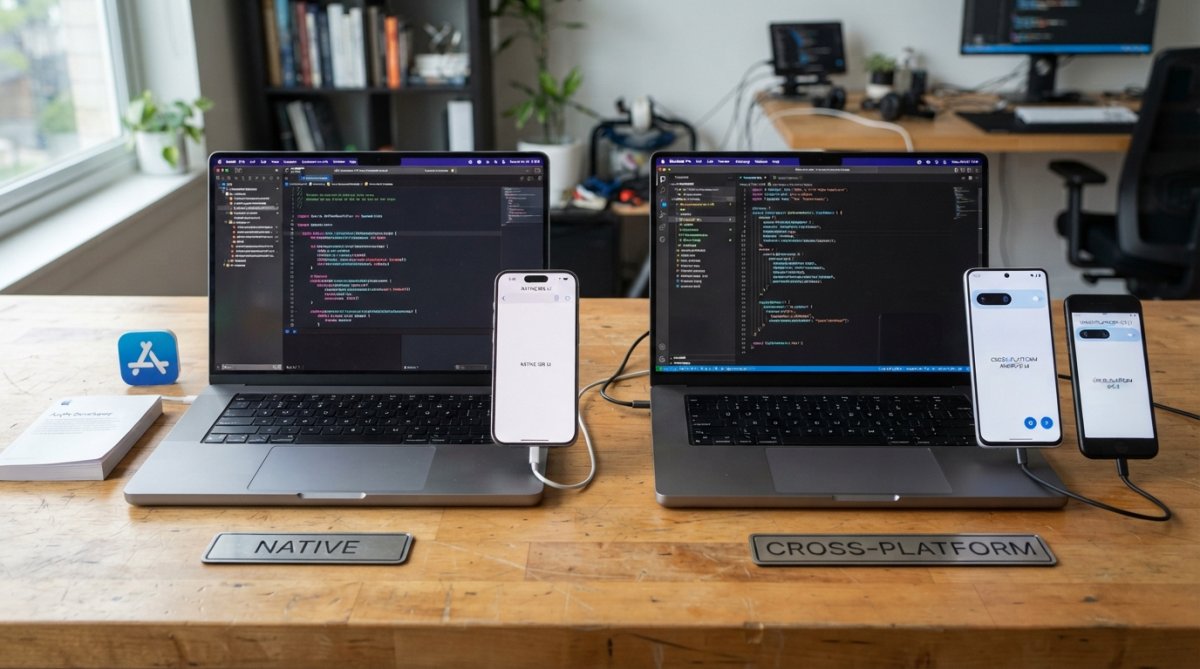
Mobile App Development Cost NZ: 2026 Pricing Guide
Table of Contents
- What Does Mobile App Development Cost in NZ? (Key Ranges)
- Key Factors That Influence Mobile App Development Cost in NZ
- App Development Timeline NZ: How Long Will Your Project Take?
- MVP Development Cost NZ: The Smarter Way to Launch
- Mobile App Maintenance Costs NZ: The Budget Most Businesses Forget
- Hidden Costs of App Development New Zealand Businesses Often Miss
- How to Hire Mobile App Developers in New Zealand
- Conclusion: Planning Your App Budget With Confidence
Last Updated: May 28, 2026
Planning a mobile app for your business is exciting right up until someone asks how much it costs. Understanding mobile app development cost nz is genuinely complex, because the answer depends on a layered set of decisions that most business owners haven’t thought through yet. This guide from Web Maniacs breaks down every cost driver, from initial scoping through long-term maintenance, so you can plan your budget with real confidence rather than guesswork. Below, we’ll show you exactly how to estimate your project, avoid the hidden costs that catch most NZ businesses off guard, and decide whether building, buying, or going no-code is the right call for your situation.
Here’s what most cost guides get wrong: they give you a number without explaining what moves it up or down. A $20,000 app and a $200,000 app can look identical in a brief. The difference lives in the decisions you make before a single line of code is written.
What Does Mobile App Development Cost in NZ? (Key Ranges)
Mobile app development cost in NZ typically falls into three tiers based on complexity, and knowing which tier your project sits in is the most important early decision you’ll make.
| Complexity Tier | NZD Budget Range | Typical Timeline | Best For |
|---|---|---|---|
| Simple App | $15,000 – $50,000 | 2-4 months | MVP, single-function tools |
| Mid-Complexity App | $50,000 – $150,000 | 4-8 months | Marketplace, booking, social |
| Complex Enterprise App | $150,000+ | 8-18+ months | ERP, fintech, multi-platform |
These ranges reflect NZ market rates for local development teams in 2026. Offshore teams can reduce costs significantly, but that trade-off deserves its own section.
Simple Apps (NZD $15,000-$50,000)
Simple apps cover a single core function: a booking tool, a loyalty card replacement, a basic information portal, or a straightforward e-commerce front-end. They typically include user authentication, a handful of screens, and minimal backend integration. Think of a local café’s order-ahead app or a tradesperson’s job-tracking tool.
At this tier, the tech stack is usually cross-platform (Flutter or React Native) to keep costs down. The user interface (UI) is clean but not highly customised, and the user experience (UX) work is focused rather than exhaustive. Don’t expect complex API development or real-time data processing at this price point.
Mid-Complexity Apps (NZD $50,000-$150,000)
This is where most serious NZ business apps land. Mid-complexity projects typically involve multi-role user systems, third-party API integrations (payment gateways, mapping, CRMs), push notifications, and a custom backend. A property management platform, a healthcare appointment system, or a two-sided marketplace all sit in this range.
The UX/UI investment increases substantially here. Proper discovery stage work, wireframing, and prototype testing become non-negotiable if you want an app that users actually adopt.
Complex Enterprise Apps (NZD $150,000+)
Complex enterprise apps involve deep backend integration with existing business systems, advanced security compliance and data protection requirements, scalable cloud hosting architecture, and often multi-platform native builds for both iOS and Android. Government-facing apps, fintech platforms, and supply chain tools fall here. Budget overruns at this tier are common when scoping is rushed.
Key Factors That Influence Mobile App Development Cost in NZ
The price of any app development project is determined by a set of interconnected decisions, not a single variable. Changing one factor almost always affects the others.
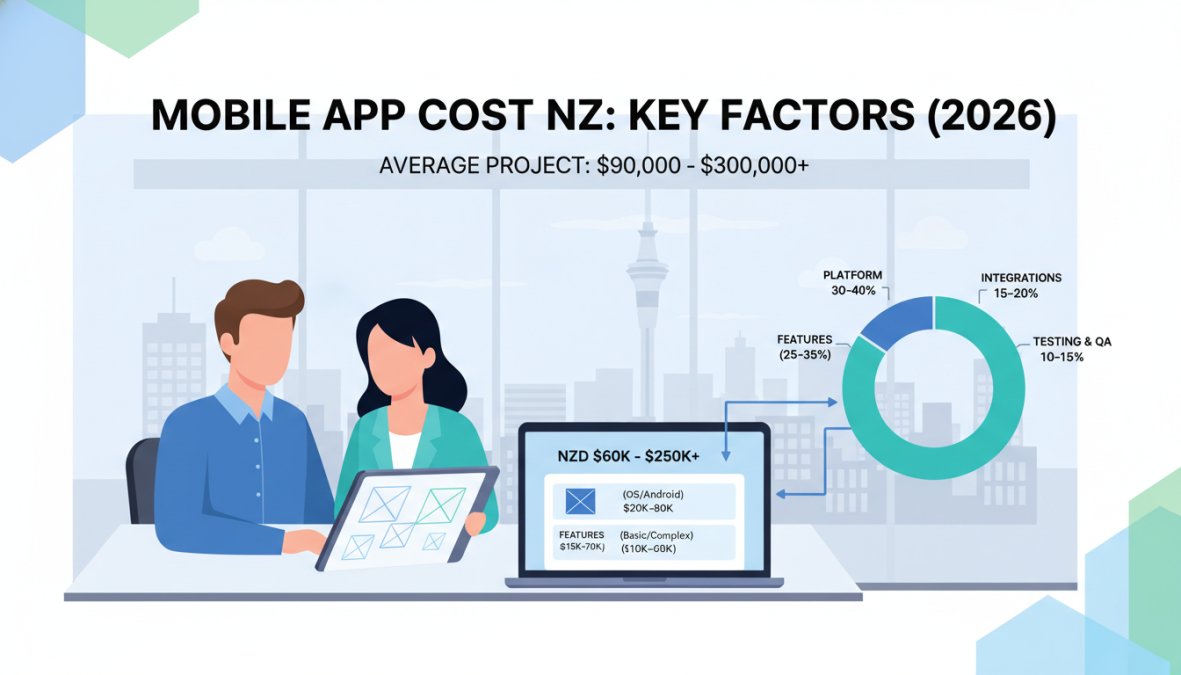
App Complexity and Feature Scope
App complexity is the single largest cost driver in any mobile app project. Every feature you add requires design, development, testing, and integration time. A social login sounds trivial but adds hours. Real-time messaging adds days. Offline functionality can add weeks.
A practical way to scope complexity is to list every app feature you want, then categorise each as "must-have for launch" versus "nice to have later." This is the foundation of MVP thinking, and it’s the fastest way to cut your initial budget without compromising your core product.
Common features and their relative cost impact:
- User authentication and profiles: low-medium
- Push notifications: low
- In-app payments and subscriptions: medium-high
- Real-time data sync: high
- Offline mode: high
- Third-party API development: medium-high (depends on API complexity)
- Admin dashboard: medium
Platform Choice: iOS, Android, or Cross-Platform
Choosing between native iOS, native Android, or a cross-platform framework like Flutter or React Native is one of the most consequential budget decisions you’ll make.
Native apps for both platforms effectively double your development cost because you’re building and maintaining two separate codebases. An iOS developer and an Android developer working in parallel is expensive. Native builds make sense when performance, platform-specific features, or app store submission requirements demand it.
Cross-platform development using Flutter or React Native reduces cost by roughly 30-40% compared to dual native builds, because a single codebase runs on both platforms. The trade-off is occasional limitations with deeply native features, though for most NZ business apps this rarely matters in practice.
If you’re unsure which platform to launch on first, look at your target audience’s device data. Many NZ business apps see a higher iOS share among professional users, while consumer-facing apps often skew Android. Start where your users already are.
Development Team Location and Hourly Rates
New Zealand-based developers typically charge NZD $100-$200+ per hour, depending on seniority and agency overhead. Australian agencies operating in the NZ market sit in a similar range. Offshore teams in Southeast Asia or Eastern Europe can charge NZD $25-$80 per hour, which sounds compelling until you factor in communication overhead, time zone friction, and the cost of fixing misaligned work.
The real cost of a cheap offshore build isn’t the hourly rate. It’s the rework budget. Many NZ businesses have learned this the hard way after receiving technically functional but commercially unusable apps.
A hybrid model works well for many projects: local discovery and UX/UI design, offshore development, local QA and project management. This captures cost savings without sacrificing the strategic alignment that requires face-to-face communication.
App Development Timeline NZ: How Long Will Your Project Take?
App development timeline NZ projects follow a predictable structure, though the duration at each stage varies significantly by complexity. Understanding the timeline matters because delayed launches have real commercial costs, especially when you’re competing for customer engagement in a fast-moving market.
A typical NZ app development project moves through these stages:
- Discovery and scoping (2-4 weeks): Requirements gathering, user research, technical architecture planning
- UX/UI design (3-6 weeks): Wireframes, prototype, user testing, visual design
- Development sprints (8-24 weeks): Agile methodology with fortnightly sprint reviews
- QA and testing (2-4 weeks): Device testing, security compliance checks, performance benchmarking
- App store submission (1-2 weeks): Apple App Store and Google Play review processes
- Post-launch iteration (ongoing): Bug fixes, feature additions based on user data
The discovery stage is where most timelines go wrong. Skipping or rushing discovery to save a few thousand dollars is the most expensive mistake NZ businesses make. Unclear requirements at the start translate to change requests mid-development, which are far more costly than getting it right upfront.
Agile methodology is excellent for managing complexity, but it requires active client involvement. If your team can’t commit to fortnightly sprint reviews and timely feedback, your timeline will slip regardless of how good your development team is.
MVP Development Cost NZ: The Smarter Way to Launch
MVP development cost NZ projects are typically 40-60% of the full product cost, and for most businesses this is the only sensible way to enter the market. An MVP (Minimum Viable Product) is not a cheap, broken version of your app. It is a deliberately scoped version that tests your core value proposition with real users before you invest in the full build.
The business logic is straightforward. According to CB Insights research on startup failure reasons, a leading cause of product failure is building something users do not actually want. An MVP surfaces that risk early, when course correction is still affordable.
For a simple NZ app, an MVP might cost NZD $15,000-$30,000. For a mid-complexity product, expect NZD $40,000-$80,000. The key is ruthless prioritisation: what is the single problem this app solves, and what is the minimum set of features required to solve it?
What a Well-Scoped NZ MVP Actually Includes
A common mistake is treating MVP as a synonym for "cheap." A well-scoped MVP has a clear feature boundary, not a low quality bar. For a typical NZ business app MVP, the scope usually includes:
- Core user journey only (the one flow that delivers the primary value proposition)
- User authentication and basic profile management
- One payment or transaction mechanism if the business model requires it
- Minimal but functional UI, clean and usable, not polished
- Basic analytics instrumentation so you can measure what users actually do
- App store submission for at least one platform
What a well-scoped MVP deliberately excludes: advanced personalisation, secondary user roles, admin dashboards beyond basic reporting, social features, and integrations with systems that are not critical to the core flow.
Build vs. Buy vs. No-Code: A Decision Framework for NZ Businesses
This is the question most NZ businesses skip entirely, and it is often the most consequential one. Custom development is not always the right answer. Before engaging any development agency, you should work through a structured decision framework, not just a gut feel.
The three paths have fundamentally different cost profiles, risk profiles, and ceiling heights:
| Decision Factor | Custom Build | Buy (SaaS/White-label) | No-Code/Low-Code |
|---|---|---|---|
| Upfront cost (NZD) | $15,000-$200,000+ | $0-$10,000 setup | $3,000-$20,000 |
| Ongoing cost | 15-25% of build/year | $500-$5,000+/month subscription | $100-$1,000/month platform fees |
| Time to first user | 3-18 months | Days to weeks | 2-8 weeks |
| Customisation ceiling | Unlimited | Low-medium | Medium (hits limits at scale) |
| Competitive differentiation | High | Low | Low-medium |
| Technical debt risk | Medium (depends on team) | Low | Medium-high at scale |
| NZ vendor lock-in risk | Low | High | High |
When custom build is the right answer:
Custom development makes sense when your app is a genuine competitive differentiator, meaning competitors cannot replicate it by subscribing to the same SaaS platform you use. It also makes sense when you need deep integration with proprietary internal systems, when your business logic is complex enough that no off-the-shelf tool can accommodate it, or when you are building a product to sell (not just use internally).
When Buy (SaaS or white-label) is the right answer:
Many NZ businesses can meet their needs with configurable platforms and never need custom development. A booking system for a service business, a loyalty programme for a retailer, or a simple e-commerce mobile experience all have mature SaaS equivalents. The honest question to ask is: "Is the way we do this genuinely different from how every other business in our category does it?" If the answer is no, a SaaS platform is almost certainly cheaper and faster.
Examples relevant to NZ businesses:
- Booking and scheduling: Timely (NZ-founded), Mindbody, Acuity Scheduling
- Loyalty programmes: Stamp Me, Yollty, or white-label loyalty platforms
- E-commerce mobile experience: Shopify’s mobile app builder, or a progressive web app on top of an existing Shopify store
- Field service management: ServiceM8 (popular with NZ tradespeople), Fergus
The trade-off is vendor dependency: if the SaaS provider changes pricing, discontinues the product, or is acquired, your business is exposed. For core operational tools, that risk deserves explicit consideration.
When no-code/low-code is the right answer:
No-code tools have matured significantly and are a legitimate option for a defined set of use cases. The platforms most commonly used for NZ business apps:
- Bubble: Best for web-based apps with moderate complexity. Handles databases, user authentication, and workflows without code. Suitable for internal tools, MVPs, and marketplace prototypes. Pricing starts free and scales to several hundred USD per month for production use.
- Glide: Best for simple data-driven apps built on top of Google Sheets or Airtable. Excellent for internal operations tools, job tracking, inspection checklists, staff directories. Very fast to build (days, not months).
- Adalo: Designed specifically for mobile apps. Handles basic CRUD functionality, push notifications, and simple integrations. Good for customer-facing apps with limited complexity.
- FlutterFlow: A visual builder that outputs real Flutter code, which means the ceiling is higher than most no-code tools and the output can be handed to a developer for extension. Increasingly popular for NZ MVP projects.
No-code has a real ceiling. Performance degrades as data volume grows. Customisation options run out when business logic becomes complex. And if you eventually need to migrate off a no-code platform to custom development, you are largely starting from scratch, the no-code build does not give you reusable code assets.
The decision framework in practice: Start by asking whether a SaaS platform already solves your problem. If yes, buy it. If no, ask whether your MVP can be validated with a no-code build in 4-8 weeks. If yes, build it in no-code first. Only commission custom development when you have validated demand and confirmed that neither SaaS nor no-code can scale to meet it.
The No-Code Feasibility Check: A One-Day Exercise
Before engaging a custom development agency, a no-code feasibility check is worth doing. The process takes roughly one working day:
- List your MVP’s core user flows (the three to five things a user needs to be able to do)
- Map each flow to a no-code platform’s capabilities, most platforms have feature lists and community forums where you can verify feasibility in under an hour
- Estimate the no-code build cost, most no-code agencies or freelancers in NZ charge NZD $3,000-$15,000 for a production-ready no-code app
- Identify the specific limitations that would prevent the no-code version from scaling to your 12-month user and feature projections
- Make the decision explicitly, if no-code covers 80% of your MVP needs and the 20% gap is not critical for launch, the no-code path is almost certainly the right first step
This exercise does not commit you to no-code. It gives you an informed basis for the custom development conversation, and it often reveals that the initial scope was larger than it needed to be.
If you are evaluating a custom development agency and they have not asked you whether a no-code or SaaS solution might meet your needs, that is worth noting. A development agency has a commercial incentive to recommend custom builds. An agency that actively helps you evaluate all three paths before recommending custom development is demonstrating the kind of commercial alignment you want in a long-term partner.
Mobile App Maintenance Costs NZ: The Budget Most Businesses Forget
Mobile app maintenance costs NZ businesses consistently underestimate, and this is where many app projects quietly fail after launch. An app is not a one-time purchase. It’s an ongoing operational cost.
Annual maintenance typically runs 15-25% of the initial development cost. For a $100,000 app, budget NZD $15,000-$25,000 per year for:
- OS updates (iOS and Android release major updates annually, requiring compatibility work)
- Security patches and data protection compliance
- Cloud hosting and scalability costs
- Bug fixes from real-world usage
- App store submission updates and policy compliance
- Performance monitoring and API maintenance
The businesses that get caught out are those who plan for the build but not the run. If your app depends on third-party APIs, those APIs change, deprecate features, or alter pricing. That’s not a risk, it’s a certainty.
Total Cost of Ownership (TCO) Breakdown
Total Cost of Ownership (TCO) for a mobile app is the complete financial commitment over a defined period, including development, maintenance, infrastructure, and internal team time. Most cost guides stop at the build cost. TCO is what you actually spend.
A realistic TCO model for a mid-complexity NZ app over three years:
| Cost Category | Year 1 | Year 2 | Year 3 |
|---|---|---|---|
| Development (build) | $80,000 | $0 | $0 |
| New features/iteration | $0 | $20,000 | $25,000 |
| Maintenance and updates | $5,000 | $15,000 | $15,000 |
| Cloud hosting | $3,000 | $4,000 | $5,000 |
| Internal PM time | $10,000 | $8,000 | $8,000 |
| Total | $98,000 | $47,000 | $53,000 |
Three-year TCO: approximately NZD $198,000. That’s the real number to take to your board or investor, not the initial build cost.
Hidden Costs of App Development New Zealand Businesses Often Miss
The quoted project cost is rarely the final project cost. In a market as small as New Zealand’s, where development teams are limited and project managers often wear multiple hats, hidden costs compound faster than they do in larger markets. What follows is not a generic warning list, it is a category-by-category breakdown with realistic NZD exposure ranges and a pre-contract audit checklist you can use before signing anything.
1. Scope Creep (Exposure: 15-35% of original contract value)
Scope creep is the single largest hidden cost in NZ app projects, and it is almost never the developer’s fault alone. It happens because requirements that felt clear in a brief turn out to be ambiguous once design begins. Every clarification that changes the spec mid-sprint costs more than it would have cost during discovery, sometimes three to five times more, because the developer has to context-switch, unpick existing work, and re-test.
The mechanism matters: most NZ agencies quote on a time-and-materials or capped-scope basis. If your contract is time-and-materials, every change request is billable at your developer’s day rate. If it is fixed-scope, changes trigger formal variation orders that reset the timeline and often the budget ceiling.
What to do before signing: Ask your agency for their formal change request (CR) process in writing. A reputable agency will have a documented CR workflow with a defined turnaround time for cost estimates. If they don’t, that is a red flag.
2. Third-Party API and Service Costs (Exposure: NZD $2,000-$20,000+ per year, scaling with usage)
Development quotes almost never include the ongoing cost of the third-party services your app depends on. These costs are real, they recur, and some of them scale in ways that surprise businesses at growth stage.
Common third-party costs NZ apps incur:
| Service Type | Typical Cost Model | Indicative Annual Cost (NZD) |
|---|---|---|
| Payment gateway (e.g., Stripe, Windcave) | Per-transaction % + fixed fee | Scales with revenue, budget separately |
| Mapping / geolocation (e.g., Google Maps Platform) | Per API call above free tier | $500-$5,000+ depending on usage |
| SMS notifications (e.g., Twilio, MessageBird) | Per message sent | $500-$3,000+ depending on volume |
| Push notification service (e.g., Firebase, OneSignal) | Free tier then per-device or per-message | $0-$2,000+ |
| Analytics platform (e.g., Mixpanel, Amplitude) | Per monthly tracked user | $0-$5,000+ |
| Cloud hosting (AWS, Google Cloud, Azure) | Usage-based | $1,500-$10,000+ depending on architecture |
The risk is not just the cost, it is the dependency. APIs deprecate features, change authentication requirements, and alter pricing tiers. When Google Maps Platform restructured its pricing in 2018, many apps saw their mapping costs increase by several multiples overnight. That is not a historical curiosity; it is a pattern that repeats across the API ecosystem.
What to do before signing: Ask your agency to produce a third-party services register as part of the technical architecture document. Every external dependency should be listed with its current pricing model and a note on how the app would be affected if that service changed or was discontinued.
3. Legal, Privacy, and Compliance Costs (Exposure: NZD $3,000-$15,000 upfront; ongoing review annually)
New Zealand’s Privacy Act 2020 imposes specific obligations on any app that collects personal information, which is almost every app. If your app operates in healthcare, finance, or any regulated sector, the compliance surface area is substantially larger.
Costs that businesses routinely underestimate:
- Privacy impact assessment: Required for apps handling sensitive personal data. A specialist privacy lawyer in NZ typically charges NZD $3,000-$8,000 for a thorough assessment.
- Terms of service and privacy policy drafting: Generic templates downloaded from the internet are not adequate for NZ law. Proper legal drafting costs NZD $1,500-$4,000.
- App store policy compliance review: Apple’s App Store Review Guidelines and Google Play’s Developer Policy Centre both have requirements around data disclosure, in-app purchase mechanics, and content that require legal and technical review before submission. Rejections cost time and money.
- Healthcare and fintech compliance: Apps touching health records (even indirectly) or financial transactions face additional obligations under the Health Information Privacy Code and Financial Markets Conduct Act respectively. Budget separately and engage a specialist early.
Privacy Act 2020 compliance is not optional and it is not a one-time exercise. If your app’s data handling changes, new features, new third-party integrations, new user types, your privacy obligations change with it. Build an annual compliance review into your maintenance budget.
4. User Acquisition and App Store Optimisation (Exposure: NZD $5,000-$30,000+ in year one)
This is the hidden cost that most frequently derails NZ app projects, because it is treated as someone else’s budget line until it isn’t. An app with no users is an expensive piece of infrastructure. The NZ market is small, which means organic discovery through app store search is limited, you cannot rely on volume to compensate for weak ASO or absent marketing.
Costs to budget explicitly:
- App Store Optimisation (ASO): Keyword research, screenshot design, description copywriting, and A/B testing of store listings. A professional ASO setup costs NZD $2,000-$5,000. Ongoing optimisation is a monthly cost.
- Launch marketing: Paid social, influencer partnerships, PR, and email campaigns to drive initial installs. NZ launch budgets for business apps typically run NZD $5,000-$20,000 for a credible launch.
- Ratings and review strategy: Apps with fewer than ten reviews are statistically disadvantaged in app store algorithms. A structured early-adopter programme to generate authentic reviews requires planning and sometimes incentive budget.
What to do before signing: Treat user acquisition as a line item in your app business case, not an afterthought. If your ROI model assumes a certain number of active users by month six, work backwards from that number to understand what acquisition cost per install you can afford, then validate that against realistic NZ market CPIs.
5. Internal Time and Organisational Readiness (Exposure: NZD $10,000-$40,000 in year one, often invisible)
The most invisible hidden cost is your own team’s time. App development requires active client involvement, sprint reviews, feedback cycles, content provision, user testing coordination, and stakeholder sign-off. In a small NZ business, that time comes from people who have other jobs.
A mid-complexity app project typically requires:
- A product owner or internal project lead: 20-40% of their time for the duration of the build
- Subject matter expert availability for requirements sessions: several days across the project
- Staff training for internal-facing apps: half-day to full-day sessions per team
- Customer service team briefing for customer-facing apps: documentation, FAQ preparation, escalation path design
None of this appears in a development agency’s quote. All of it is real cost.
Pre-Contract Hidden Cost Audit Checklist
Before signing any app development contract, work through this checklist:
- Has the agency produced a third-party services register with current pricing models?
- Is there a documented change request process with a defined cost-estimate turnaround?
- Have you budgeted separately for legal review, privacy assessment, and terms drafting?
- Is there a line item in your business case for user acquisition in year one?
- Have you estimated internal team time and assigned it a cost?
- Does your maintenance budget cover OS updates, API changes, and annual compliance review?
- If your app uses usage-based third-party services, have you modelled costs at 2x and 5x your expected user volume?
As noted in Gartner’s guidance on software project cost management, hidden costs in software projects frequently add 20-40% to initial estimates when not proactively managed. In the NZ context, where project teams are smaller and there is less institutional experience managing software delivery, that figure can run higher.
How to Hire Mobile App Developers in New Zealand
Hiring the right development partner is as important as any technical decision you’ll make. The NZ market has a relatively small pool of experienced mobile app developers, which means due diligence matters more here than in larger markets.

Your evaluation checklist when assessing NZ app development partners:
- Can they show NZ-based case studies with measurable outcomes?
- Do they offer a formal discovery stage before quoting?
- What is their tech stack, and can they justify the choice for your project?
- How do they handle scope changes? Is there a formal change request process?
- What does post-launch support look like, and what does it cost?
- Are they familiar with NZ-specific compliance requirements (Privacy Act, industry regulations)?
- Do they use agile methodology with regular client touchpoints?
- Can they provide references from projects of similar complexity?
Web Maniacs offers personalised mobile app development with a focus on intuitive UX design and results-driven outcomes. The team works through a structured discovery process to scope projects accurately before development begins, which is the single best protection against budget overruns.
Agencies like Smudge and Catch Design serve the NZ market with strong portfolios in enterprise and government work respectively, while Elegant Media brings ISO-certified processes and a proprietary cost optimisation approach. The right choice depends on your project’s complexity, your budget, and how much ongoing partnership you need post-launch.
NZ Tax Incentives and Grants for App Development
New Zealand businesses developing software products may be eligible for R&D tax incentives that significantly reduce the net cost of app development. This is one of the most underutilised cost levers in the NZ market.
According to Callaghan Innovation’s R&D funding programmes, eligible businesses can claim a 15% tax credit on qualifying R&D expenditure. For a $100,000 development project where a meaningful portion qualifies as R&D, this represents real money back.
Key points to understand:
- The R&D Tax Incentive applies to eligible expenditure on developing new or improved products, processes, or services
- Software development frequently qualifies, particularly where the work involves resolving genuine technical uncertainty
- You must apply in advance and maintain documentation of qualifying activities
- Minimum eligible expenditure thresholds apply
Beyond tax incentives, Callaghan Innovation offers direct grants for product development, and some regional economic development agencies provide co-funding for digital transformation projects. Engaging an R&D tax specialist before your project starts, not after, is the practical move. The documentation requirements are specific and retroactive claims are harder to support.
The net effect for a qualifying NZ business: a $150,000 development project could cost significantly less after incentives are factored in. That changes the ROI calculation materially.
For NZ businesses pursuing digital transformation through mobile apps, also review the New Zealand Trade and Enterprise digital capability support programmes for additional funding pathways.
Conclusion: Planning Your App Budget With Confidence
Budgeting for a mobile app is genuinely difficult when you’re working from incomplete information, and most NZ businesses start the process without a clear picture of what drives cost, what’s hidden, and what the three-year commitment actually looks like. Web Maniacs provides custom mobile app development tailored to NZ businesses, with personalised scoping, intuitive UX design, and a transparent process that gives you the full cost picture before you commit. Get started with Web Maniacs and build an app that delivers measurable business outcomes, not just a product that launches and stalls.
Frequently Asked Questions
How much does it cost to develop a mobile app in NZ?
Mobile app development cost in NZ typically ranges from NZD $15,000 for a simple MVP to over NZD $150,000 for a complex, enterprise-grade application. The final figure depends on app complexity, chosen platform (iOS, Android, or cross-platform), the development team's location, and the feature set required. Getting a detailed project scoping session before committing to a budget is strongly recommended.
What is the difference between MVP and full-scale app development costs in NZ?
MVP development cost in NZ is significantly lower because you build only the core features needed to validate your idea, often NZD $15,000-$40,000. A full-scale app includes advanced UI/UX, backend integration, API development, and broader platform support, pushing costs much higher. Starting with an MVP reduces financial risk and gives you real user feedback before investing in the complete product.
Do I need a maintenance budget for my mobile app in NZ?
Yes. Mobile app maintenance costs in NZ are often overlooked but typically run 15-20% of the original development cost annually. This covers app store submission updates, security compliance patches, cloud hosting, bug fixes, and OS compatibility as iOS and Android release new versions. Factoring maintenance into your total cost of ownership from day one prevents costly surprises post-launch.
Is it cheaper to hire an NZ app developer or outsource overseas?
Hiring a local New Zealand development agency costs more per hour than offshore teams, but offers advantages in communication, time zone alignment, and understanding of the local market. Offshore teams in regions like Eastern Europe or South Asia charge lower hourly rates but can introduce project management complexity. For many NZ businesses, a hybrid approach, local project management with offshore development, balances cost and quality effectively.
How long does it take to build a mobile app in NZ?
App development timelines in NZ vary by complexity. A simple app using agile methodology can be delivered in 2-4 months, while a mid-complexity app typically takes 4-8 months. Enterprise-level applications with deep backend integration, custom API development, and rigorous security compliance can take 9-18 months. A thorough discovery stage and clear project scoping at the outset help keep timelines realistic and on track.
This article was written using GrandRanker