
Hybrid App Development Explained for Non-Technical Founders
Table of Contents
- What Is Hybrid App Development Explained for Non-Technical Founders
- Hybrid vs Native App Development: What Founders Need to Know
- Benefits of Hybrid App Development for New Zealand Startups
- Cost of Hybrid App Development in New Zealand
- Popular Hybrid App Development Frameworks for Your MVP
- When to Choose Hybrid App Development Over Native
- Hybrid vs Cross-Platform vs Progressive Web Apps: Which Path for Your Startup
- Finding Developer Talent for Hybrid App Development in New Zealand
Last Updated: July 30, 2026
What Is Hybrid App Development Explained for Non-Technical Founders
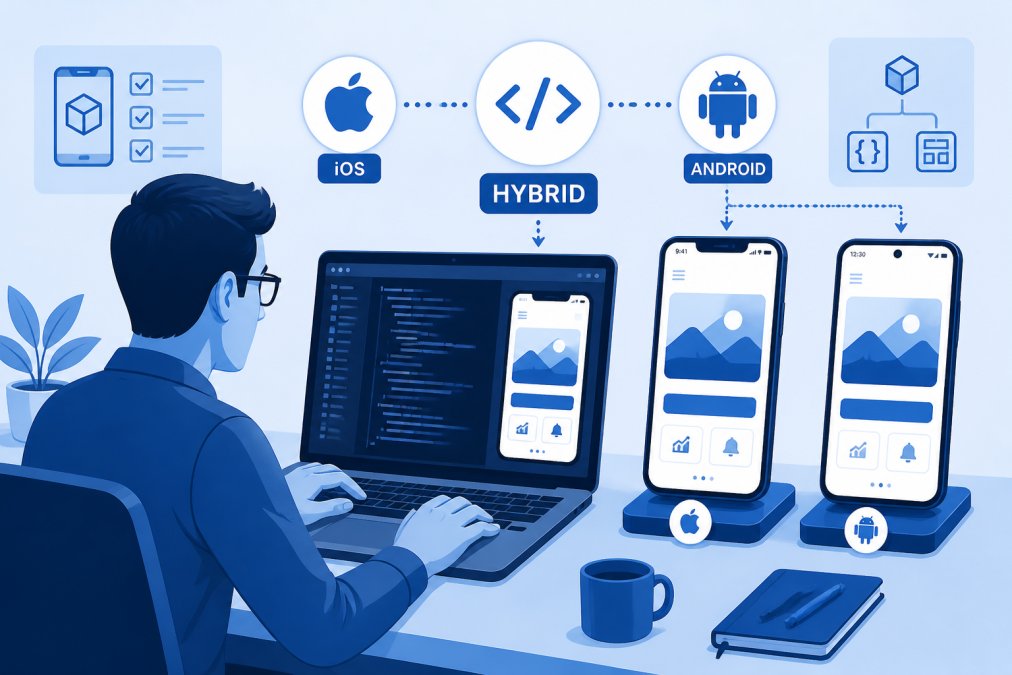
Building a mobile app no longer requires choosing between expensive native development and compromised web solutions. Hybrid app development is the practical middle ground: a single codebase written in web technologies that deploys to both iOS and Android, eliminating the need to build two separate applications.
Hybrid apps use HTML, CSS, and JavaScript wrapped inside a native container that provides access to device features like cameras, GPS, and push notifications. Frameworks like React Native and Flutter now deliver performance nearly indistinguishable from purely native apps for most use cases. According to Gartner’s 2026 Mobile Development Report, organisations choosing hybrid approaches reduce time-to-market by 40-60% compared to native-first strategies.
How a Single Codebase Works Across Devices
The magic of hybrid development lies in abstraction. Your code communicates with a bridge layer that translates instructions into native API calls for each platform. You write your app logic once in JavaScript, React, or Dart, and the framework packages that code with a lightweight native wrapper for deployment to the App Store or Google Play.
This architecture solves the fundamental problem of cross-platform development: code reusability. Instead of maintaining separate iOS and Android codebases that inevitably drift apart, you maintain one source of truth. Bug fixes, feature updates, and design changes happen once, not twice.
The real efficiency gain isn’t just in initial development, it’s in maintenance. A feature that takes two weeks to build natively takes 3-4 days with a hybrid framework, and updates roll out simultaneously to both platforms.
Web Technologies Inside a Mobile App
Your hybrid app runs inside a WebView, essentially a browser engine embedded in a native application shell. Frameworks like Ionic provide pre-built components that mimic iOS and Android design patterns.
The critical difference from Progressive Web Apps is that hybrid apps have full access to device APIs. Your code can trigger the camera, read contacts, send SMS messages, or store data offline. Modern hybrid frameworks like React Native and Flutter don’t use WebViews; they compile directly to native components, delivering near-native speed while maintaining code reusability.
Hybrid vs Native App Development: What Founders Need to Know
Native apps are written specifically for one platform using that platform’s native language. iOS uses Swift; Android uses Kotlin. Hybrid apps require trade-offs in specialisation but sacrifice nothing in capability. For most startups building marketplaces, booking systems, or service platforms, this trade-off favours hybrid development.
The cost difference is substantial. Native development requires hiring iOS and Android developers, two specialists with different skill sets. Hybrid development requires one team of full-stack developers, translating to 30-50% lower development costs.
One genuine limitation: if your app requires deep platform-specific features (like advanced AR capabilities or complex device integrations), native development may be necessary. However, 80% of business applications never hit this ceiling.
Performance and User Experience Differences
The performance gap between hybrid and native has collapsed. React Native and Flutter compile to native code, not interpreted JavaScript. Your app runs at speeds comparable to native applications for standard operations: scrolling, animations, form input, and network requests.
User experience consistency is where hybrid shines. Your design looks and functions identically on iOS and Android. When you discover a usability issue, you fix it once and deploy to both platforms simultaneously, rather than fixing it in two places and waiting for two separate app store approvals.
App Store Approval and Device Feature Access
Both the Apple App Store and Google Play accept hybrid apps without discrimination. Device feature access through hybrid frameworks is comprehensive: camera, microphone, contacts, calendar, GPS, accelerometer, and most other sensors. The practical limitation is that newer device features sometimes take weeks for frameworks to support, though this rarely affects most applications.
Benefits of Hybrid App Development for New Zealand Startups
The primary advantage for New Zealand founders is resource efficiency. Hybrid development lets you move faster and cheaper, which matters enormously in the critical first 18 months. Research from [McKinsey’s 2026 Software Development(/custom-software-development-services-nz/) Study | mckinsey.com] shows that companies launching products 40% faster gain significant competitive advantage.
The second advantage is team flexibility. A developer skilled in React can build hybrid apps with React Native. You’re not locked into hiring specialists in obscure languages, which matters in New Zealand’s smaller talent market.
Code Reusability and Faster Development
Writing code once and deploying to two platforms is the core promise of hybrid development. A feature that would take two weeks to build natively takes 3-4 days with hybrid frameworks.
| Development Task | Native (iOS + Android) | Hybrid | Time Saved |
|---|---|---|---|
| Initial feature build | 10-14 days | 3-4 days | 65-70% |
| Bug fix deployment | 5-7 days | 1-2 days | 70% |
| Design update | 3-5 days | 1 day | 75% |
| Performance optimisation | 4-6 days | 2 days | 60% |
Reduced Development Cost and Team Requirements
Native app development requires at least two developers: one iOS specialist and one Android specialist. In New Zealand, experienced mobile developers command salaries between NZ$90,000 and NZ$140,000 annually. Hybrid development requires one full-stack developer or a small team of JavaScript-skilled developers at NZ$80,000-NZ$120,000 annually, representing 40-50% cost savings immediately.
A hybrid app costs 40-50% less to build and maintain than equivalent native apps, with development timelines compressed by 60-70%. For startups, this efficiency is transformational.
Cost of Hybrid App Development in New Zealand
Total cost depends on application complexity, team location, and framework choice. Pricing for a simple MVP with basic features, user authentication, and data display, a mid-complexity application with custom backend integration and payment processing, or a complex application with real-time features and advanced integrations is available on the Web Maniacs website. Application scope is the primary cost driver; more features mean more development time. Design complexity, backend integration, and team location all affect cost significantly.
No-Code vs Low-Code vs Custom Development
No-code platforms like Adalo let non-technical founders build applications without writing code. Adalo publishes true native iOS and Android apps from a single codebase, starting at approximately NZ$60 per month. You can build and launch a functional app in days rather than months.
The limitation is flexibility. No-code platforms excel at standard use cases: marketplaces, booking systems, directory apps. If your application requires custom logic or highly specific features, no-code platforms struggle.
Low-code platforms like SAP Build Apps sit between no-code and custom development, providing visual development tools with the ability to write custom code when needed. For a non-technical founder with a simple MVP, no-code platforms like Adalo offer exceptional value. For a founder with a more complex vision, low-code or custom development is necessary.
Popular Hybrid App Development Frameworks for Your MVP
React Native dominates the hybrid development landscape. Created by Meta, React Native uses JavaScript and React principles to build native apps. Companies like Shopify, Coinbase, and Uber use React Native. The framework compiles to native code, delivering near-native performance with a mature ecosystem and large developer community.
Flutter is Google’s alternative, using the Dart programming language. Flutter compiles to native code and delivers excellent performance. The framework is newer than React Native but growing rapidly, with hot-reload features that make development extremely fast.
Ionic uses web technologies (HTML, CSS, JavaScript) with Angular, React, or Vue frameworks. Ionic is ideal if your team has web development skills. For no-code development, Adalo stands out by publishing true native iOS and Android apps.
React Native and Flutter for Native Performance
React Native’s strength is its ecosystem and developer availability. Most web developers can learn React Native quickly because it uses JavaScript and React patterns they already know. Flutter’s strength is developer experience, with exceptional hot-reload features and a comprehensive widget library.
For a New Zealand startup hiring local developers, React Native is the safer choice because more developers know JavaScript. Both frameworks deliver native performance; the choice is largely about team skills and preference.
Ionic and Cordova for Web Technology Developers
Ionic is ideal if your team consists of web developers who want to build mobile apps without learning new languages. Ionic apps run in a WebView, meaning they’re technically hybrid rather than truly native. For most applications, marketplaces, booking systems, content apps, the performance difference is negligible.
No-Code Platforms: Adalo, Glide, and Bubble
Adalo publishes true native iOS and Android apps from a visual builder. Non-technical founders can build functional apps in days, with a relational database, user authentication, and payment processing, starting at NZ$60 per month.
Glide creates Progressive Web Apps from spreadsheets or databases. Glide is excellent if your data lives in Google Sheets and you want to build a quick interface around that data. However, Glide doesn’t publish native mobile apps to the App Store or Google Play.
When to Choose Hybrid App Development Over Native
Choose hybrid development if your timeline is tight, your budget is limited, or your team consists of full-stack developers rather than platform specialists. Hybrid development is ideal for MVPs and early-stage products. Choose native development if your app requires extreme performance (games, real-time rendering), deep platform-specific features, or if you’re building for a single platform only.
Time-to-Market and MVP Launch Considerations
Time-to-market is where hybrid development shines. A hybrid MVP can launch in 2-4 months. An equivalent native MVP typically takes 4-6 months or longer. This time advantage is crucial for startups because market timing matters enormously. The faster launch allows you to test your business hypothesis earlier.
Scalability, Technical Debt, and Long-Term Maintenance
Hybrid development doesn’t sacrifice scalability. Your application scales based on your backend infrastructure, not on whether you used hybrid or native frameworks. Technical debt is where hybrid development shows an advantage. You’re maintaining one codebase, not two, meaning one place to fix bugs and implement security updates. Maintenance costs for hybrid apps are typically 30-40% lower than equivalent native apps.
Hybrid development reduces maintenance costs by 30-40% and prevents technical debt from accumulating across multiple codebases. For long-term sustainability, hybrid development is the more pragmatic choice for most applications.
Hybrid vs Cross-Platform vs Progressive Web Apps: Which Path for Your Startup
Hybrid apps are web code inside a native wrapper. React Native and Flutter are technically "cross-platform native" frameworks, compiling to native code rather than running in a WebView.
Progressive Web Apps (PWAs) are websites that behave like apps. They install on your home screen, work offline, and send push notifications. For most startups, hybrid apps are the better choice than PWAs because they distribute through app stores, providing discovery and legitimacy.
When PWAs Make Sense Instead of Hybrid Apps
Progressive Web Apps are ideal if your primary audience is desktop users or mobile web users. PWAs work across all browsers and devices without requiring app store approval.
PWAs are ideal if you want to avoid app store gatekeeping. PWAs bypass the 30% commission and policy restrictions that Apple and Google impose. The limitation of PWAs is discoverability. Users find apps through app stores; they find PWAs through web search or direct links. For consumer applications relying on app store discovery, PWAs are a disadvantage. For B2B applications, a PWA might be ideal.
Cross-Platform Frameworks Beyond Hybrid
Xamarin (now .NET MAUI) is Microsoft’s cross-platform framework using C# and .NET. NativeScript uses JavaScript or TypeScript to build truly native apps. The practical reality is that React Native and Flutter dominate the market. Most job postings for hybrid development are for these two frameworks.
Finding Developer Talent for Hybrid App Development in New Zealand
New Zealand has a growing pool of React Native and Flutter developers. Wellington and Auckland have the largest concentrations. Salaries for experienced hybrid developers range from NZ$80,000 to NZ$120,000 annually, comparable to full-stack web developers.
Finding local talent is easier than finding native specialists because hybrid development uses languages (JavaScript, Dart) that are taught widely. Many web developers can transition to hybrid development with weeks of training.
Hiring Full-Stack Teams vs Outsourcing to Agencies
Building an in-house team makes sense if you’re committed to building multiple products or maintaining your application long-term. Outsourcing to an agency makes sense if you’re building your first MVP and want to validate your idea before committing to a full team.
Web Maniacs offers project-based development for startups building their first MVP. For companies building long-term products, Web Maniacs can provide ongoing maintenance and feature development.
What to Look for in a Hybrid App Development Partner
Look for a partner with demonstrated experience in hybrid frameworks (React Native or Flutter). Ask for case studies and references. Look for a partner who understands your business, not just your technical requirements.
Look for a partner who communicates clearly and frequently. Development surprises are expensive. Regular communication prevents misunderstandings and keeps projects on track. Look for a partner who can scale with you as your MVP grows.
Web Maniacs provides expert digital solutions, including custom software development, website design, and mobile app creation, tailored to help your business thrive online. Our approach combines custom development with strategic guidance, ensuring your technical decisions align with your business goals. We handle the full lifecycle: from MVP launch through scaling and ongoing maintenance. Get started with Web Maniacs and transform your app idea into a revenue-generating product that reaches both iOS and Android users without the cost and complexity of native development.
Frequently Asked Questions
What is hybrid app development and how does it differ from native apps?
Hybrid app development uses a single codebase built with web technologies like HTML5, CSS, and JavaScript to create apps for iOS and Android simultaneously. Unlike native apps, which are built separately for each platform using platform-specific languages, hybrid apps wrap web code in a native container. This approach reduces development time and cost but may have slightly lower performance compared to truly native applications optimised for each mobile operating system.
What are the main benefits of hybrid app development for New Zealand startups?
Hybrid app development offers significant advantages for startups: code reusability across iOS and Android reduces development cost and time-to-market, you need fewer developers with expertise in a single codebase rather than multiple languages, and maintenance becomes simpler. For early-stage founders with tight budgets, hybrid frameworks like React Native and Flutter allow you to launch an MVP quickly, test your business model, and scale later without rewriting your entire application.
How much does hybrid app development cost compared to native development?
Hybrid app development is typically 30-50% cheaper than building separate native apps because you're maintaining one codebase instead of two. Costs depend on complexity, features, and whether you use no-code platforms (starting from NZ$60-115 per month for tools like Adalo or Bubble) or hire developers (typically NZ$151-200+ per hour for custom work). A basic MVP might cost NZ$8,000-20,000 with hybrid frameworks, versus NZ$15,000-40,000+ for native development.
What frameworks should I consider for hybrid app development in New Zealand?
Popular hybrid frameworks include React Native and Flutter for high-performance native-feeling apps, Ionic for web developers using JavaScript, and no-code platforms like Adalo, Glide, and Bubble for non-technical founders. React Native and Flutter offer better performance and access to native device features, while Ionic is ideal if you have web development skills. No-code platforms eliminate coding entirely but may have limitations for highly complex applications. Choose based on your team's skills, timeline, and performance requirements.
Hybrid app development represents the pragmatic path forward for most New Zealand startups. You get native performance and app store distribution without the cost and complexity of building two separate applications. The frameworks are mature, the developer talent exists, and the cost savings are substantial. The only question is which framework fits your team’s skills and your timeline. Start with your business goals, not your technical preferences, and the right choice becomes obvious.
This article was written using GrandRanker