
CRM Integration Cost for NZ Businesses: A 2026 Guide
Table of Contents
- What Is CRM Integration and Why It Costs More Than Software Alone
- Breaking Down Total Cost of Ownership for CRM Integration
- Xero CRM Integration Cost: What NZ Businesses Actually Pay
- CRM Data Migration Costs: Planning Your Budget
- CRM Implementation Services in NZ: DIY vs Professional Agency
- Cloud-Based vs On-Premise CRM Integration: Cost Comparison
- Key Features That Affect CRM Integration Cost for NZ Businesses
- Calculating Return on Investment: Making CRM Integration Pay
Last Updated: August 3, 2026
What Is CRM Integration and Why It Costs More Than Software Alone
Understanding CRM integration cost for New Zealand businesses requires separating two distinct expenses: the software subscription itself and the integration work that makes it actually useful. A CRM subscription covers platform access, typically charged per user per month. Integration cost covers everything else: connecting your CRM to existing systems, migrating historical data, customising workflows, training staff, and ongoing technical support. For many businesses, integration costs exceed the software cost by 2-3 times.
The difference between CRM software and CRM integration
CRM software is the platform itself, the dashboard where your sales team manages leads, tracks deals, and logs customer interactions.
CRM integration is the work of making that software work with your actual business. It’s connecting your accounting system (like Xero), your email, your marketing automation tools, your payment processor, and your inventory management. It’s cleaning up five years of customer data so it can be imported without corruption. It’s building custom fields and automation rules that match how your team actually works. A business might pay $50 per user per month for HubSpot or Pipedrive, but if you need to integrate with Xero, migrate 50,000 customer records, build custom workflows, and train 15 staff members, you’re looking at a project that runs weeks or months, not days.
Why integration complexity drives cost
Integration cost depends on three factors: data volume, system complexity, and customisation depth.
Data volume matters because migration isn’t instant. A small business with 5,000 customer records can migrate in hours. A mid-sized business with 100,000 records requires careful data mapping, validation, and cleansing.
System complexity is about how many tools you need to connect. A solo contractor using only CRM and email might need one integration. A retailer using CRM, e-commerce platform, accounting software, inventory management, email marketing, and customer support tools needs six integrations. Each connection point is a potential failure mode.
Customisation depth is about how far you’re willing to adapt your processes. You can take a CRM "out of the box" and force your team to work within its constraints, or you can customise fields, workflows, automation rules, and reporting to match how your business actually operates.
The real cost of CRM integration isn’t the subscription, it’s the labour to connect it to your actual business, clean your data, and train your team to use it properly.
Breaking Down Total Cost of Ownership for CRM Integration
Total Cost of Ownership (TCO) for CRM integration includes subscription fees, data migration, onboarding, training, customisation, and ongoing support.

Subscription fees and per-user licensing
Subscription fees are the most visible cost but rarely the largest. Most cloud-based CRM platforms charge per user per month, with pricing tiers based on features. Entry-level tools cost $10-20 per user per month. Mid-market platforms typically run $30-100 per user per month. Enterprise solutions can exceed $200 per user per month. For a team of 10 people, that’s roughly $300-1,200 per month, or $3,600-14,400 annually. Annual billing usually offers a 10-15% discount versus monthly billing.
Data migration and onboarding costs
Data migration requires three steps: extraction, cleansing, and validation.
Extraction means pulling data out of wherever it currently lives. Cleansing means fixing problems: duplicate records, incomplete fields, inconsistent formatting, outdated information. Validation means confirming the data imported correctly by manually checking a sample of records against the original source.
For a small business with clean data in a single system, migration might cost $500-1,500. For a mid-sized business with messy data across multiple sources, expect $2,000-5,000. Large enterprises sometimes invest $10,000-50,000 in migration alone.
Training and technical support expenses
Staff training determines whether your CRM becomes a valuable tool or expensive shelf-ware. Initial training typically covers the basics for a team of 10-15 people, costing $500-2,000 for a full-day workshop. Role-specific training is more valuable: sales staff need to understand lead management, customer service teams need to understand customer history, managers need to understand reporting.
Ongoing technical support is critical. Someone on your team needs to be the CRM administrator, or you’ll need to contract it out. Support contracts typically cost $500-2,000 per month.
Customisation and hidden fees
Out-of-the-box CRM tools work well for generic use cases. Most businesses have unique requirements: custom fields, specific workflows, integration with proprietary systems, or reporting that doesn’t match standard templates. Custom field creation usually costs $50-200 per field. Workflow automation costs $500-2,000 per workflow. API integration with third-party systems can run $1,000-5,000 per integration.
Many CRM implementations exceed budget because teams underestimate customisation needs. Build 20-30% contingency into your initial budget for unexpected customisation requirements that emerge during setup.
Xero CRM Integration Cost: What NZ Businesses Actually Pay
Xero is ubiquitous in New Zealand accounting, which makes Xero CRM integration a common requirement for NZ businesses.
Xero’s native integrations versus third-party connectors
Xero offers native integrations with several popular CRM platforms, including HubSpot, Pipedrive, and Zoho CRM. Native integrations are pre-built connections maintained by both companies, which means they’re stable and typically cheaper to implement. Setup typically takes a few hours and costs $500-1,500 in professional labour, or nothing if you can handle it internally.
Third-party connectors like Zapier or Make offer more flexibility but require more setup. A Zapier integration between Xero and a non-native CRM might cost $50-100 per month in Zapier credits plus professional setup fees of $1,000-3,000.
API integration requirements and developer time
If you need deep integration between Xero and your CRM, syncing custom fields, automating invoice creation based on deals, or creating bidirectional updates, you’ll need API-level integration. This requires a developer with experience in both Xero’s API and your CRM’s API. API integration typically costs $2,000-8,000 depending on complexity, usually taking 1-4 weeks. Budget $500-1,000 per year for maintenance and updates.
Before commissioning custom API integration, check if a native integration or third-party connector already handles 80% of your requirements. You might save $3,000-5,000 by using an existing solution.
CRM Data Migration Costs: Planning Your Budget
Data migration is often the hidden cost that surprises businesses. A poorly executed migration can corrupt your data and create duplicate records. A well-executed migration takes time and money but pays dividends in data quality.
Data volume and complexity assessment
Start by understanding what you’re migrating. How many records? How many fields per record? How many systems are involved? A small business with 5,000 customer records in a single spreadsheet is straightforward. A mid-sized business with 50,000 records across a legacy system, a spreadsheet, and email is complex.
Cleansing, mapping, and validation expenses
Data cleansing typically costs $500-2,000 for small datasets, $2,000-10,000 for mid-sized datasets, and $10,000+ for large or complex datasets. Mapping is the process of translating fields from your old system to your new CRM, budgeting $1,000-3,000. Validation is the final check, typically costing $500-1,500 for a sample of 500-1,000 records from a 50,000-record dataset.
CRM Implementation Services in NZ: DIY vs Professional Agency
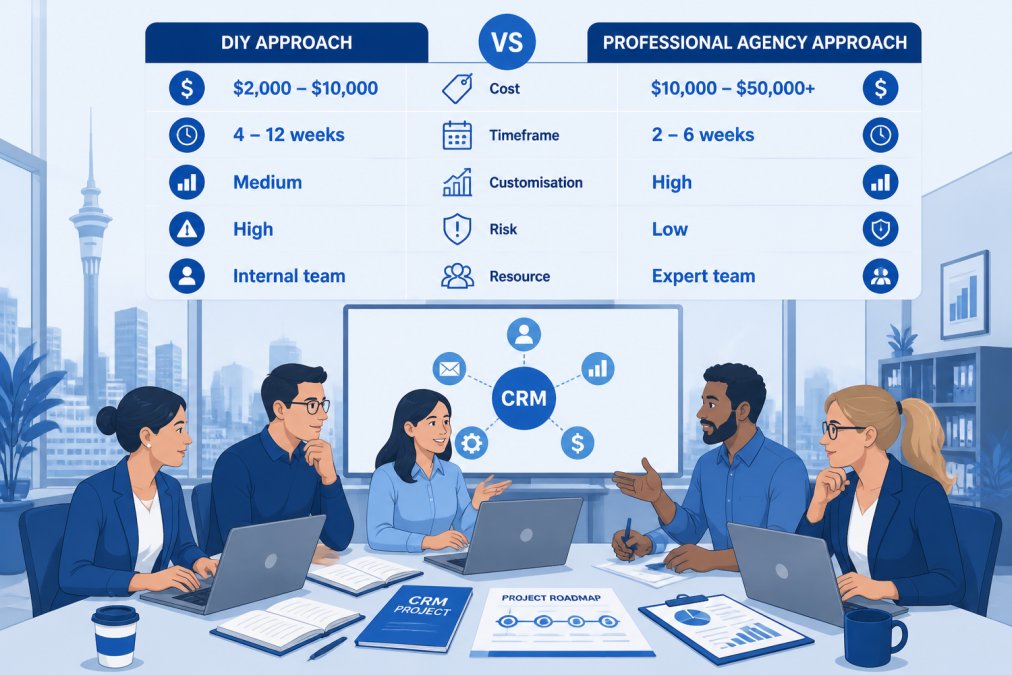
The choice between implementing CRM yourself and hiring a professional agency significantly affects both cost and outcome.
When to use an NZ-based implementation partner
DIY implementation works for simple deployments: a single-user CRM, minimal customisation, no data migration, no integration requirements. For anything more complex, professional implementation is necessary. A professional implementation partner brings expertise, speed, and accountability. An NZ-based partner understands local business practices, can provide timezone-appropriate support, and is familiar with NZ-specific compliance requirements. Implementation partners typically charge $5,000-20,000 for a complete project, depending on scope.
Timeline impact on total project cost
Implementation timeline directly affects cost. A quick implementation (2-4 weeks) is cheaper because it requires fewer hours and less back-and-forth. A typical professional implementation timeline is 4-8 weeks: 1 week for discovery and planning, 2-3 weeks for configuration and customisation, 1-2 weeks for data migration and testing, 1 week for training and launch.
Cloud-Based vs On-Premise CRM Integration: Cost Comparison
The deployment model significantly affects both upfront and ongoing costs.
Cloud-based CRM (SaaS) is the standard for most businesses today. You pay a subscription fee, the vendor handles infrastructure and maintenance, and you access it through a web browser. Integration costs are typically lower because the vendor provides APIs and pre-built connectors. Implementation is faster because there’s no infrastructure to set up.
On-premise CRM requires you to host the software on your own servers. Upfront costs are higher: software licenses, server hardware, network infrastructure. Ongoing costs include server maintenance, security updates, backups, and IT staff.
Cloud-based CRM typically costs 30-50% less to implement than on-premise solutions when you factor in infrastructure, maintenance, and IT labour costs.
Key Features That Affect CRM Integration Cost for NZ Businesses
Not all CRM features are equally expensive to integrate. Some require minimal work, while others significantly increase implementation complexity and cost.
Third-party integrations and API connectivity
The number of third-party integrations you need dramatically affects cost. A CRM that only connects to email and accounting software is simple. A CRM that needs to connect to email, accounting, marketing automation, e-commerce platform, customer support system, inventory management, and payment processing is complex. Each integration adds $500-2,000 to your implementation cost. Choosing a CRM with strong API support saves money and reduces headaches.
Workflow automation and lead management complexity
Workflow automation is powerful but expensive to build. A simple workflow (when a lead is created, send a welcome email) costs $200-500 to configure. A complex workflow (when a deal reaches $50,000, create an invoice in Xero, send a notification to the manager, and log the action in the customer history) might cost $2,000-5,000.
Compliance, data security, and NZ-specific requirements
New Zealand has specific privacy and data protection requirements that affect CRM implementation. The Privacy Act 2020 governs how you collect, store, and use customer data. Some CRMs have built-in compliance features (audit logs, data encryption, access controls) that align with NZ requirements. Others require custom configuration. Ensuring your CRM meets NZ compliance requirements might add $1,000-3,000 to your implementation cost.
Calculating Return on Investment: Making CRM Integration Pay
The real measure of CRM integration cost is whether it delivers value. A $10,000 implementation that saves your business $2,000 per month in operational efficiency is a good investment.
Measuring operational efficiency gains
CRM value comes from operational efficiency: time saved, errors reduced, and processes accelerated.
Time savings: If your team of five people spends 5 hours per week on manual CRM-type tasks, that’s 1,300 hours per year. At an average salary cost of $40 per hour, that’s $52,000 in labour cost. A CRM that reduces this by 50% saves $26,000 per year.
Error reduction: If your team currently spends 10 hours per week fixing data errors, a CRM might reduce this to 2 hours per week, saving $16,640 per year.
Process acceleration: If a CRM reduces your sales cycle by 5 days, that’s $12,500 in additional revenue per month for a business processing $250,000 in monthly deals.
Customer lifecycle value and retention impact
Beyond operational efficiency, a CRM improves customer relationships and retention. Better customer data means better personalisation. Improved retention is valuable. If a CRM helps you retain just 5% more customers than you currently do, and your average customer lifetime value is $5,000, that’s an additional $25,000 per year in retained revenue.
| Benefit | Typical Annual Value | How to Measure |
|---|---|---|
| Labour time savings | $20,000-50,000 | Hours saved × hourly cost |
| Error reduction | $10,000-30,000 | Errors fixed × cost per error |
| Sales cycle acceleration | $15,000-60,000 | Days saved × daily revenue |
| Customer retention improvement | $10,000-50,000 | Additional retained customers × lifetime value |
| Upsell and cross-sell | $5,000-25,000 | Additional deals × average deal size |
| Total typical annual benefit | $60,000-215,000 | Sum of all benefits |
A CRM integration that costs $15,000 and delivers $100,000 in annual benefits has a payback period of less than 2 months and an ROI of 567% in the first year.
Frequently Asked Questions
How much does CRM integration cost for a typical small business in New Zealand?
CRM integration cost varies significantly based on software choice, data volume, and complexity. Subscription fees range from monthly per-user licensing to annual billing models. Beyond software, expect costs for data migration, customization, training, and implementation services. Total cost of ownership typically includes setup fees, API integration work, and ongoing technical support. The actual figure depends on your business size, existing systems, and integration requirements. Contact Web Maniacs for a tailored quote based on your specific needs.
What factors influence the cost of Xero CRM integration cost in New Zealand?
Xero CRM integration cost depends on how many systems need connecting, data migration complexity, and whether you need custom API development. Native integrations cost less than third-party connectors requiring developer time. Your data volume, field mapping requirements, and the need for workflow automation all add to expenses. Compliance with NZ data security standards may require additional setup. Whether you choose DIY or hire an NZ-based implementation partner significantly affects total cost. Discuss your specific Xero setup with a specialist to get an accurate estimate.
Are there hidden costs when integrating CRM software with existing business systems?
Yes. Beyond subscription fees, CRM data migration costs include data cleansing, validation, and mapping work that specialists often charge separately. Third-party integrations may require API development or middleware setup. Training expenses, ongoing technical support, and customization for your workflow optimization needs add up quickly. Some vendors charge for user licensing differently than expected, and annual billing may include surprise renewal fees. NZ-specific compliance integration, such as tax software connectivity, can increase costs. Request a detailed breakdown of all fees upfront to avoid surprises.
Should I hire a local NZ CRM implementation services provider or handle integration in-house?
Local NZ CRM implementation services providers understand local compliance requirements, tax integration with Xero or MYOB, and business practices specific to the market. They reduce project timeline risk and provide ongoing support. In-house implementation saves on service fees but requires skilled staff and takes time away from core operations. For complex data migration, API integration, and workflow automation, professional implementation typically delivers faster results and lower long-term costs. Small businesses often find that outsourcing implementation to an NZ specialist provides better return on investment than attempting it internally.
This article was written using GrandRanker