Web Design for Website: A 2026 Guide
Table of Contents
- What Web Design for Website Actually Means
- Why Your Website Design Matters to Your Business
- Core Principles of Effective Web Design
- Mobile Responsive Web Design Essentials
- UX Design Best Practices for Higher Engagement
- Web Design Process Steps: From Concept to Launch
- Website Design Cost Considerations
- Modern Design Trends and Accessibility
Last Updated: August 22, 2026
What Web Design for Website Actually Means
Web design for website is the strategic process of creating the visual layout, user interface, and interactive elements that shape how visitors experience your online presence. It’s the intersection of design, user psychology, and business objectives working together to convert visitors into customers.
Many businesses confuse web design with web development. Design is about how the site looks and feels; development is the technical engineering that makes it function. When they’re aligned, results follow.
According to InternetNZ Research 2025, 97% of people check a company’s online presence before deciding to visit or buy. The stakes are immediate: 94% of first impressions are design-driven, meaning your layout, colour palette, typography, and visual hierarchy determine whether someone stays or leaves before reading a single word.
:::takeaway
Web design for website isn’t decoration. It’s a conversion tool that bridges the gap between what your business offers and what your customers actually need to see.
:::
Why Your Website Design Matters to Your Business
According to ColorWhistle UI/UX statistics, 88% of users are less likely to return to a website after a bad user experience. Well-designed user experience can increase conversion rates by up to 400%.
InternetNZ’s 2025 research found that 61% of businesses consider a website their most important digital tool, yet only 53% actually have one. Those that do are seeing measurable returns.
The real problem isn’t whether web design matters. It’s that most businesses treat it as a one-time project rather than an ongoing conversion system.
:::warning
A poorly designed website doesn’t just fail to convert, it actively damages your brand. Visitors who experience friction, slow load times, or confusing navigation assume your business operates the same way.
:::
Core Principles of Effective Web Design
User-centric design and visual hierarchy
User-centric design means every decision serves the visitor’s needs. Visual hierarchy guides users through your content in order of importance, using contrast, size, and positioning to direct attention.

According to RANK website design research for trades businesses, 83% of online users expect websites to load in three seconds or less. But speed alone isn’t enough. If visitors can’t find what they’re looking for, speed becomes irrelevant.
Web design for website that prioritises users typically includes:
- Clear navigation structure with no more than 5-7 primary menu items
- Whitespace that reduces cognitive load and improves readability
- Consistent typography choices (maximum 2-3 font families)
- Colour palettes that guide attention, not distract
- Mobile-first responsive layout that works seamlessly across devices
Conversion-focused design strategies
Conversion-focused design answers a specific question: what action do you want visitors to take? Every element should either support that goal or get out of the way.
This means understanding user journey mapping, the path a visitor takes from landing on your site to completing the desired action. A common mistake is adding too many options. Visitors paralysed by choice often choose nothing.
Brand consistency directly impacts retention, with 32% of customers abandoning brands after inconsistent experiences.
Conversion-focused principles include:
- Single, clear primary call-to-action per page
- Trust signals (testimonials, case studies, security badges) placed strategically
- Minimal form fields (only ask what you actually need)
- Fast load times
- Mobile optimisation (nearly two-thirds of all web traffic comes from mobile devices)
:::tip
Test your conversion funnel by walking through it yourself on mobile. If you wouldn’t complete the action as a user, your visitors won’t either.
:::
Mobile Responsive Web Design Essentials
Mobile-responsive web design is the baseline. Over 90% of people in this region access the internet via mobile devices. Your web design for website must function flawlessly on smaller screens, or it’s fundamentally broken.
Mobile-first design means building for mobile first, then scaling up to desktop. This results in cleaner, faster, more focused sites. Responsive layout means your site adapts fluidly to any screen size using grid systems that allow content to reflow intelligently.
Critical mobile considerations for web design for website:
- Touch targets (buttons and links) must be at least 44 pixels square
- Text must be readable without zooming (minimum 16px font size)
- Avoid horizontal scrolling
- Reduce image file sizes for faster mobile loading
- Simplify navigation to accommodate smaller screens [EXTERNAL_LINK: AI design previews | vireous.shop].
According to research from Syspree and Web Design Trends, designing primarily for mobile devices first ensures an optimal experience for the majority of users.
UX Design Best Practices for Higher Engagement
UX (user experience) design focuses on how your site feels to use. The distinction between UI and UX matters. UI is what visitors see; UX is what they feel, whether the site is intuitive and whether they accomplish their goal.
Best practices for UX design include:
- Consistency across all pages, Use the same navigation structure, button styles, and layout patterns throughout.
- Clear information architecture, Organise content logically so users understand where they are and how to get where they need to go.
- Accessibility standards, Design for everyone, including people with visual, hearing, or motor impairments. A11y Pulse tested 27 web agencies and found that only 4 received a ‘good’ accessibility score of 90 or above.
- Interactive elements that respond, Buttons should feel clickable. Forms should provide feedback. Hover states should indicate interactivity.
- Content strategy, Your web design for website should support your content, not compete with it.
:::bestfor
Teams building their first professional website or redesigning an outdated one. These practices apply universally.
:::
Web Design Process Steps: From Concept to Launch
Planning and discovery
The web design for website process begins with discovery, where you define the problem you’re solving. Start with stakeholder interviews to understand success metrics, users, pain points, and desired actions.
Conduct user research by surveying existing customers and analysing web analytics to see where visitors drop off. Create a project brief that documents your goals, audience, timeline, and budget.
Design and prototyping
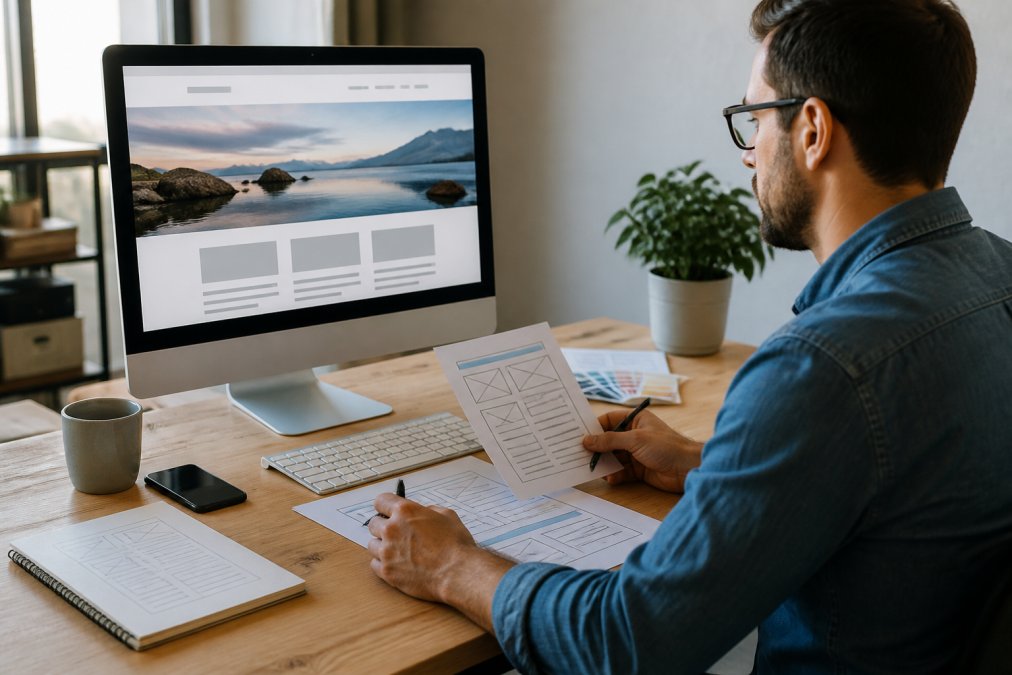
With discovery complete, design begins with wireframing, low-fidelity sketches that establish layout and content structure. Next comes prototyping with high-fidelity mockups showing real colours, typography, and imagery.

Prototyping lets you test ideas before investing in development, confirming that users can find what they need and the visual hierarchy guides attention correctly.
Development and testing
Development is where design becomes reality. Front-end developers build the HTML, CSS, and JavaScript; back-end developers handle databases and integrations. Testing happens throughout, including functionality, performance, and cross-browser testing.
Quality assurance catches bugs before launch, and user acceptance testing brings real people in to provide feedback.
Website Design Cost Considerations
The cost of web design for website varies based on scope. Factors affecting cost include complexity, customisation, integrations, ongoing support, and timeline.
Rather than quoting generic figures, assess your specific needs for transparent pricing. The real question isn’t "How much does a website cost?" It’s "What return on investment do I need to justify the cost?" A website that generates leads, increases sales, or reduces support costs pays for itself.
:::takeaway
Website design cost is an investment, not an expense. The cheapest option often becomes the most expensive when it fails to convert.
:::
Modern Design Trends and Accessibility
Web design for website in 2026 reflects several converging trends. AI-powered personalisation is reshaping how sites adapt to individual visitors. According to TEKsystems NZ IT Market Trends 2025, 97% of organisations are accelerating AI deployment, creating demand for websites optimised for both traditional search and AI-powered discovery.
Minimalism continues to dominate, with neobrutalism emerging as a raw, stripped-down aesthetic. Both trends share a focus on clarity and intentionality.
Sustainable web design is gaining traction through smaller images, cleaner code, and optimised performance, which reduces energy footprint and improves site speed.
Accessibility has moved from compliance checkbox to core design standard. According to A11y Pulse, nearly half of web agencies received a ‘poor’ accessibility score below 70. Accessible design improves usability for everyone and increasingly influences procurement decisions.
Web design for website that prioritises accessibility includes:
- Sufficient colour contrast (at least 4.5:1 for text)
- Keyboard navigation support
- Alt text for all images
- Semantic HTML structure
- Clear focus indicators
The Web Content Accessibility Guidelines (WCAG) provide the framework. Aiming for WCAG AA compliance ensures your site is usable by people with disabilities and performs better overall.
The difference between a website that works and one that doesn’t comes down to intention. Every choice either serves your business goal or distracts from it. Web design for website isn’t about creating something beautiful. It’s about creating something that works.
Web Maniacs specialises in web design for website that converts. We combine user-focused design principles with conversion optimisation and technical excellence to build sites that strengthen your brand identity, increase visibility, and generate measurable results. Whether you need a custom web application, a redesigned website, or a complete digital overhaul, we deliver personalised solutions designed to connect you with customers and drive sustainable growth. Get started with Web Maniacs and transform your online presence into a competitive advantage.
=== FAQ ANSWERS (audit these too, same rules) ===
[1] Q: What is the 3-second rule in website design?
A: The 3-second rule refers to the expectation that websites should load within three seconds or less. Research shows 83% of online users expect this speed. A one-second delay in loading can significantly impact conversions and user satisfaction. This matters because slow sites frustrate visitors and increase bounce rates, directly affecting your ability to convert traffic into customers or leads.
[2] Q: How does mobile-responsive web design impact SEO?
A: Mobile-responsive design is essential for SEO because search engines prioritise mobile-friendly websites. Nearly 62% of all web traffic comes from mobile devices, and Google’s ranking system rewards sites that perform well on mobile. A responsive layout automatically adjusts to different screen sizes, ensuring users have a good experience whether they’re on a smartphone, tablet, or desktop. This improves engagement metrics that search engines measure.
[3] Q: What role does user experience (UX) play in web design?
A: UX is central to web design success. Well-designed UX can increase conversion rates by up to 400%, while 88% of users are less likely to return after a bad experience. Good UX means visitors can find what they need easily, navigate intuitively, and complete desired actions without friction. This directly translates to more customers, higher sales, and stronger brand loyalty.
[4] Q: How do I choose the right web design approach for my business?
A: Start by defining your goals: do you need a brochure site, an e-commerce platform, or a custom application? Consider your audience, budget, and timeline. For small businesses, drag-and-drop builders offer speed and affordability. For complex requirements like WooCommerce optimisation or custom functionality, professional development is worth the investment. Assess whether you need ongoing support, SEO integration, or conversion optimisation, these factors determine which approach fits best.
Frequently Asked Questions
What is the 3-second rule in website design?
The 3-second rule refers to the expectation that websites should load within three seconds or less. Research shows 83% of online users expect this speed. A one-second delay in loading can significantly impact conversions and user satisfaction. This matters because slow sites frustrate visitors and increase bounce rates, directly affecting your ability to convert traffic into customers or leads.
How does mobile-responsive web design impact SEO?
Mobile-responsive design is essential for SEO because search engines prioritise mobile-friendly websites. Nearly 62% of all web traffic comes from mobile devices, and Google's ranking system rewards sites that perform well on mobile. A responsive layout automatically adjusts to different screen sizes, ensuring users have a good experience whether they're on a smartphone, tablet, or desktop. This improves engagement metrics that search engines measure.
What role does user experience (UX) play in web design?
UX is central to web design success. Well-designed UX can increase conversion rates by up to 400%, while 88% of users are less likely to return after a bad experience. Good UX means visitors can find what they need easily, navigate intuitively, and complete desired actions without friction. This directly translates to more customers, higher sales, and stronger brand loyalty.
How do I choose the right web design approach for my business?
Start by defining your goals: do you need a brochure site, an e-commerce platform, or a custom application? Consider your audience, budget, and timeline. For small businesses, drag-and-drop builders offer speed and affordability. For complex requirements like WooCommerce optimisation or custom functionality, professional development is worth the investment. Assess whether you need ongoing support, SEO integration, or conversion optimisation, these factors determine which approach fits best.
This article was written using GrandRanker